
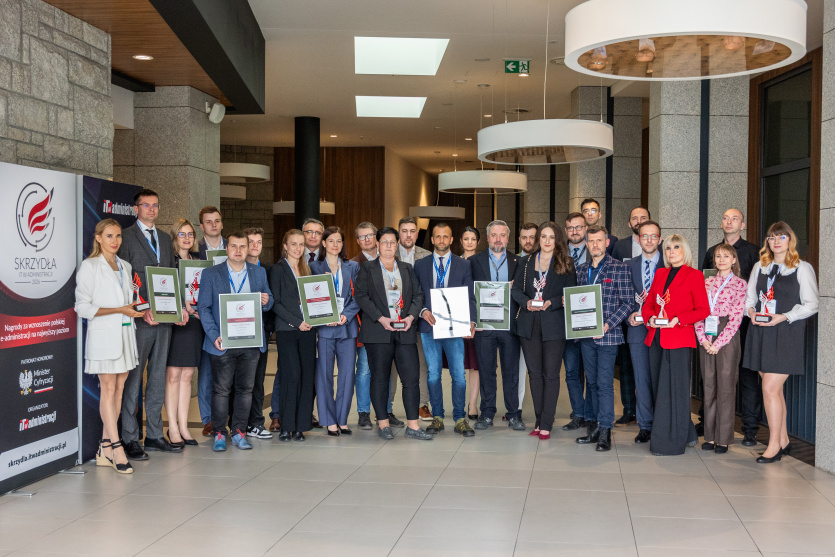
The Minister for Digital Affairs special award in the ‘IT Wings in Administration’ competition for an innovative and pioneering project in the field of higher education and science ‘UG Management Information System - Manager Dashboards’ was collected during a gala ceremony by the Vice-Rector for Development and Finance at the University of Gdańsk, dr hab. Paweł Antonowicz, prof. UG, and the Financial Director, mgr Marzena Wojtaszko. ‘IT Wings’ is an award presented annually to the best IT projects implemented by public institutions.
The ‘IT Wings in Administration’ competition recognises tools that facilitate access to public services and improve the quality of service and communication with citizens and other public authorities. The competition honours projects that serve as role models in terms of implementation and the benefits achieved.
The innovation of the University of Gdańsk’s Management Information System (System Informacji Zarządczej, known as SIZ - management dashboards) lies in the synergy of technology (Power BI - Business Intelligence), processes, and management culture. This solution not only digitises administration but also tangibly enhances its managerial maturity, turning multi-domain data into a key strategic asset for the university. The system comprises four modules: Student, Teaching, Human Resources and Finance.
‘The University of Gdańsk Management Information System is an example of a mature, scalable and secure IT solution that effectively supports the management of a large public organisation. The project not only streamlines day-to-day processes but also lays the foundation for long-term financial, organisational and strategic efficiency, serving as a model solution that can be benchmarked and replicated in other public sector institutions,’ says the Vice-Rector for Development and Finance at the University of Gdańsk, dr hab. Paweł Antonowicz, prof. UG, who is responsible for the system at the university.
The implementation of the SIZ has yielded tangible results in several key areas:
1. Speed and quality of decision-making
- access to up-to-date data in near real time,
- elimination of manual reporting and repetitive data processing,
- a single ‘source of truth’ for the entire organisation.
2. Process efficiency
- reduction in the time taken to prepare analyses and management reports,
- automation of periodic reports,
- reduction in the risk of errors arising from manual data processing.
3. Tangible financial benefits
- better control of costs and revenues at university and faculty level,
- optimisation of teaching workloads, including for part-time programmes,
- reduction of costs associated with unused leave,
- more effective management of receivables (debt collection).
4. Support for the university’s sustainable development
- rational planning of the teaching programme based on recruitment data and drop-out analyses,
- better alignment of human resources with students’ actual needs,
- integration of the Management Information System (MIS) with the strategy reporting system (BSC).
‘Modern management of a public university today means making decisions based on reliable, up-to-date and appropriately processed data. The University of Gdańsk’s Management Information System - management dashboards - is an example of a solution that genuinely supports management staff, increasing the efficiency of processes and the managerial maturity of the entire organisation. The special award from the Minister for Digital Affairs, presented to the University of Gdańsk in the ‘IT Wings in Administration’ competition, confirms that the digital transformation of administration we are implementing is innovative and can serve as a model for other public sector institutions’ emphasised the Rector of the University of Gdańsk, prof. dr hab. Piotr Stepnowski.
The following individuals were involved in the creation of the ‘UG Management Information System - Management Dashboards’ project: UG Vice-Rector for Development and Finance, dr hab. Paweł Antonowicz, prof. UG; UG Chancellor dr hab. inż. Aneta Oniszczuk, prof. UG, Financial Director of UG mgr Marzena Wojtaszko, Head of the Office of Controlling at UG mgr Krzysztof Dalke, Deputy Head of the Office of Controlling mgr Bartłomiej Lubiejewski, Director of the UG IT Centre Magdalena Bugaj and her deputy Łukasz Gugniewicz.
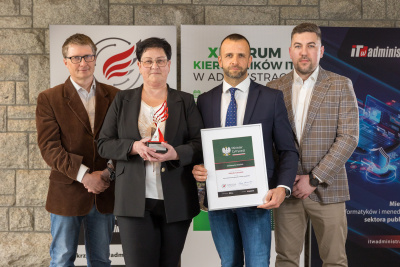
The award was presented during a gala ceremony in Zakopane on 15 April 2026, attended by the Vice-Rector for Development and Finance at the University of Gdańsk, dr hab. Paweł Antonowicz, prof. UG; the Financial Director of the University of Gdańsk, mgr Marzena Wojtaszko, Head of the Office of Controlling, mgr Krzysztof Dalke, and Deputy Head of the Office of Controlling, mgr Bartłomiej Lubiejewski. The special award was received from a representative of the Ministry of Digital Affairs on behalf of the University of Gdańsk by the Vice-Rector for Development and Finance of the University of Gdańsk, together with the Financial Director of the University of Gdańsk.
SIZ - Management Information System
In today’s world, information is crucial for the development of any organisation. The quality of management information, in turn, determines the quality of managerial decisions. To this end, an innovative Management Information System (SIZ) has been developed at the University of Gdańsk. The implementation of the project has significantly increased the speed and availability of data, particularly financial data. This has enabled a swift response to rapidly changing economic conditions. As a result of the MIS implementation, all staff - including management - have been granted constant access to key information related to their daily business processes. This solution has significantly improved decision-making efficiency at every level of the organisation and supports the University’s further development. This objective was achieved using the Power BI Report Server by integrating dispersed information from various programmes and databases. The Management Information System is built using the most advanced reporting tool on the market. It enables the elimination of errors through direct access to databases, whilst also enhancing the decision-making process and optimisation capabilities of authorised users.
The Management Information System comprises the following modules:
Student Module
The ‘Admissions’ dashboard enables a precise analysis of the sources from which prospective students come to the University. This also has a significant social dimension - thanks to data on the number of local and non-local students, it is possible to reliably estimate the demand for places in halls of residence. The tool also allows for the ongoing modification and improvement of the programme offering, so that it increasingly meets the educational needs of applicants.
An important complement to this solution is the ‘drop-out’ dashboard, which provides information on student turnover across individual degree programmes, supporting decision-making in the areas of curriculum management and educational quality.
Teaching Module
This module includes, amongst other things, a teaching load dashboard, which supports the optimal structuring of teaching workloads across individual degree programmes in a clear and transparent manner. Ongoing verification of the planned teaching load (right up until it is finalised) enables flexible and accurate allocation of teaching staff, taking into account current student needs and staff availability.
Personnel Management Module
To support the faculty management team, the ‘Holidays’ dashboard has been created. It displays, in real time, both the taken and planned holidays of each employee. This solution significantly reduces costs associated with unused holiday entitlement, whilst enabling staff to fully recharge - without negatively impacting the University’s operations.
Finance Module
The system is complemented by financial dashboards. These present not only an overview of the financial situation of the entire organisation, but also detailed data on individual units and ongoing tasks. Thanks to their comprehensive nature, the dashboards are used by a very wide range of users - from management down to those responsible for specific tasks.