
The University of Gdańsk is moving from fragmented language practices to a coherent, university-wide policy covering all key areas of academic activity! The adopted University of Gdańsk Language Policy is not merely a declaration of values, but a practical tool for the strategic management of the university, establishing common guidelines and standards for action. These include: systematic support for the development of language skills of staff and students; expanding the range of multilingual education programmes; increasing the accessibility of information for the international community and for people with special needs; developing transparent and comprehensible administrative communication in Polish and English; and strengthening the role of the Polish language in academic life and the integration of international students.
‘The Language Policy adopted by the University of Gdańsk is a modern and comprehensive document. It treats multilingualism not only as an element of education, but as an important dimension of the functioning of the entire academic community - from teaching and research, through administration, to international cooperation and communication,’ says the Vice-Rector for Cooperation and International Relations at the University of Gdańsk, dr hab. Anna Jurkowska-Zeidler, prof. UG, who led the work on drafting the document. ‘We want multilingualism to become a natural part of the academic culture at the University of Gdańsk, combining the development of the language and intercultural skills necessary to function in an international academic environment with strengthening the role of the Polish language in education, academic communication, the creation and dissemination of knowledge, and the development of scientific terminology specific to individual disciplines.’
Finding a common language on a European campus
The language policy is an instrument of strategic university management in line with the University of Gdańsk’s Development Strategy for 2025-2030, supporting the further internationalisation of the University of Gdańsk. It proposes a range of specific measures, such as: expanding the range of courses taught in English (not only by launching further degree programmes taught entirely in English, but also by introducing new elective modules taught in foreign languages), increasing the availability of language courses for students and staff (including administrative staff), ensuring the international community has access to information through the development of English-language communication channels, and introducing standards for transparent institutional communication, conducted in simple, understandable, and inclusive language, taking into account people with special needs. It also emphasises the role of the Polish language as the national language, both in domestic academic communication (including through the promotion of Polish academic terminology) and in processes of international integration (for example, by organising courses in Polish as a foreign language, which will enable international members of the academic community to become more fully integrated into Polish-speaking culture).
The measures set out in the University of Gdańsk’s Language Policy are in line with the development priorities of the European Education Area, the European Research Area, and the European Higher Education Area, which emphasise the importance of linguistic and intercultural competences, mobility, openness in academia and the free flow of knowledge. These are the competences and values essential for the future of European academic communities and for building sustainable international partnerships.
In this context, the SEA-EU alliance is of particular importance to the University of Gdańsk, as we jointly implement the principles of a language policy for nine partner universities, based on respect for all national languages and supporting the mutual learning of these languages. This is one of the key elements in building a multilingual European university and developing a common academic space in which linguistic and cultural diversity becomes an invaluable resource. Equally important is the development of proficiency in English as the contemporary lingua franca of the international community.
From good practices to a coherent strategy
‘The University of Gdańsk’s language policy has evolved from a number of good practices previously implemented in various units of the University,’ says the Rector’s Representative for Language Policy for the period 2024-2026, mgr Alina Swebocka. ‘What this gives us, above all, is the creation of a transparent, shared framework for specific actions that respond to the needs of an international, multicultural and multilingual university environment.’ Before we set about drafting it, we conducted an extensive survey aimed at assessing these needs and determining the level of language proficiency within our academic community. These activities will be continued on a regular basis throughout the implementation of the Policy. We have also examined best practices at other universities, both in Poland and across Europe, including our partners within the SEA-EU network.’
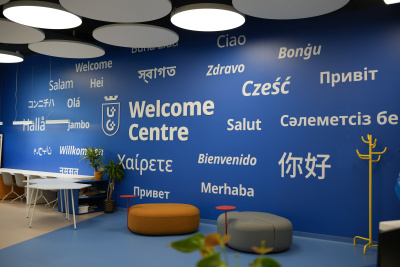
Among the fundamental principles of the University of Gdańsk’s Language Policy are a commitment to multilingual education (including, amongst other things, the expansion of degree programmes taught in foreign languages and elective modules), sustainable internationalisation (including ‘internationalisation at home’, enabling students to develop linguistic, intercultural and international competences, amongst other things through teaching sessions led by visiting academics from abroad or participation in hybrid international forms of education) and fostering a culture of continuous development of linguistic competences amongst staff and students. The need to develop administrative communication in Polish and English was also emphasised, as was the importance of professionalising the support provided to international stakeholders, e.g. through the activities of the Welcome Centre and the Euraxes network.
Implementation of the Policy is based on cooperation between the units responsible for education, the development of staff and student competences, internationalisation, communication and administrative support
‘As the Cooperation and International Relations Office, we carry out a range of activities in line with the University of Gdańsk’s Language Policy,’ says the Director of the Cooperation and International Relations Office, mgr Magdalena Sawicz. ‘Among other things, we look after international visitors, assist them - including through language support - with the necessary formalities relating to their stay in Poland, and help international students and staff adapt to life within the university’s structures and to living in the Tricity, by providing practical support as well as fostering cultural and linguistic integration. We run language courses and training programmes as part of the Erasmus+ programme and in collaboration with the National Agency for Academic Exchange. We are delighted that these efforts have taken on a new dimension, becoming an integral part of the university’s strategic management. Building a multilingual community requires the cooperation of the entire university.’
Among the University of Gdańsk units particularly involved in implementing the language policy’s objectives is also the Foreign Languages Centre.
‘In our day-to-day work, we put these principles into practice at every turn,’ comments the Director of the Foreign Languages Centre, mgr Emilia Krzywańska-Frankowska. ‘Our tasks include running modern language classes and courses for students and staff, as well as individual tuition for people with disabilities; organising Polish as a foreign language courses for Erasmus students; and supporting the University of Gdańsk community with academic communication and translation. All these activities form a strategic part of our internationalisation efforts and demonstrate that the University of Gdańsk is an open, multilingual and inclusive institution, both in terms of its values and in practical aspects.’
Linguistic integration: an integral part of academic culture
In addition to developing multilingual competences, the University of Gdańsk’s language policy provides for systematic support for the learning of the Polish language, treating linguistic integration as an integral part of academic culture and recognising the importance of the Polish language in education, academic communication, the creation and dissemination of knowledge, and the development of discipline-specific terminology. It also takes into account the special role of the Kashubian language and Kashubian culture as essential parts of Pomerania’s cultural heritage and the University’s identity.
‘From our Centre’s perspective, it is of fundamental importance that this policy defines the role of the Polish language and Polish cultural heritage as pillars of the internationalisation process,’ says the Director of the Academic Centre of Polish Language and Culture for Foreigners dr Irena Chawrilska ‘Equally important is the recognition of the Polish language’s role as one of the languages of scholarship. Thanks to this, our campus becomes a space for dynamic cultural exchange - a place where linguistic diversity does not divide, but builds a strong, integrated academic community. As a Centre, we create a space for immersion in the Polish language and Polish culture, tailoring our programme to students, researchers, University of Gdańsk staff, as well as international visitors and their families.’
The University of Gdańsk’s language policy also emphasises the importance of equality within language (including through the promotion of the use of feminine forms and non-binary forms) and linguistic accessibility in the context of support for people with special needs, including those with disabilities, with a focus on ensuring digital accessibility, translations into Polish Sign Language, labelling buildings and rooms in Braille, and making materials available in various formats.
Rector's Decree No. 101/R/2026 of the University of Gdańsk dated 11 September 2026 on the Language Policy of the University of Gdańsk is one of the few such comprehensive approaches to language issues in academic life seen to date at Polish universities. It covers all aspects of the university’s operations, from teaching and research to administrative services and the popularisation of science. The full document (in Polish) can be found here: polityka_jezykowa_ug.pdf.