Dr Alicja Mikołajczyk from the Faculty of Chemistry has been named (as the only Polish candidate) among 60 young researchers from around the world in the LUSH PRIZE 2026 competition in the Young Scientists category. The Lush Prize is the world's largest prize fund working to end the use of animals in research, testing and education.
Her research is based on modern methods of chemical and material design and risk assessment, especially for nanomaterials and advanced innovative chemicals. Dr Alicja Mikołajczyk carries out the process of designing chemicals and innovative materials in virtual space, using advanced methods of artificial intelligence, machine learning, molecular modelling and quantum chemistry. This makes it possible not only to predict the properties and risks of new substances at a very early stage, but also to significantly reduce the time and cost of research and limit in vitro and animal testing. These activities have been recognised by the Lush Prize committee, which awards the prize for efforts to end the use of animals in research, testing and education. The Lush Prize 2026 shortlist includes 60 nominations representing projects from 25 countries.
According to the founders, the Lush Prize Young Researcher Award is aimed at ambitious young scientists (aged 35 or under on the date of application). A maximum of five awards are given in this category. Each winner of the Young Researcher Award receives £10,000 in funding.
‘Being shortlisted for the Lush Prize, the world's largest prize fund supporting initiatives that end or replace animal testing, is a great honour for me and a strong confirmation of the value of my many years of work on research without the use of laboratory animals, which I carry out at the Faculty of Chemistry of the University of Gdańsk - in the Laboratory of Environmental Chemoinformatics in prof. Puzyn's team - and in QSAR Lab, a spin-off company of the University of Gdańsk,’ says dr Alicja Mikołajczyk. ‘I see this award as a clear signal that science and implementations based on a ‘human-relevant’ approach , i.e. using data and models that reflect human biology and toxicity mechanisms as accurately as possible, are becoming a real direction of change in the research and safety assessment of chemicals and advanced materials, including new-generation nanomaterials.’
As the scientist emphasises, in practice this means the increasingly widespread use of new generation methods (New Approach Methodologies, NAMs): studies conducted outside the organism on cells or tissues (in vitro) and methods based on chemical and biochemical reactions (in chemico), the results of which are combined in integrated testing and assessment strategies (Integrated Approaches to Testing and Assessment, IATA) and interpreted within the framework of pathways leading to adverse biological effects (Adverse Outcome Pathways, AOP), supplemented by computer modelling (in silico). ‘In the same spirit, the 1R concept, which aims at the complete replacement of animal testing rather than a ‘compromise’ reduction in testing, is becoming a realistic direction and a new standard in chemical safety testing and assessment,’ he adds.

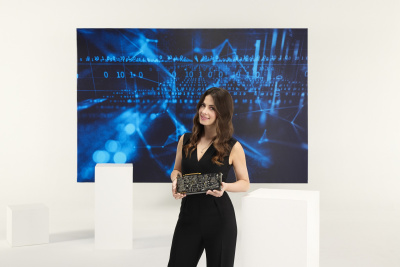
Lush Prize statuette
The Lush Prize covers five main categories: Science, Training, Public Awareness, Policy Advocacy and Young Researcher. It is in the latter category that dr Alicja Mikołajczyk has been nominated: ‘It is also a commitment to translate the in silico methods I have developed even faster - in particular, modelling quantitative relationships between structure and activity (Quantitative Structure-Activity Relationship, QSAR) for advanced and innovative materials (IAM) – into practical and regulatory-acceptable solutions to better protect human health through appropriate risk management of chemical compounds and materials throughout the product life cycle, while effectively moving away from animal testing.’
Dr Alicja Mikołajczyk has received many prestigious awards, including a scientific award presented at the ChinaNanomedicine 2023: Nanomedicine Discovery and Translation conference, the Rising Star in Material Science 2023 award and a scholarship from the 24th edition of the L’Oréal-UNESCO For Women in Science programme. And in May 2025, she was appointed to the Scientific Advisory Board of UNESCO's International Basic Sciences Programme (IBSP).
The winners will be announced at a ceremony in May this year.
https://lushprize.org/2026-prize/2026-prize-shortlist/