science

science
Researchers from the University of Gdańsk have once again been included in the prestigious list of the top 2 per cent of the world’s most influential scientists. The list is compiled and updated annually by Stanford University in collaboration with the UG Publishing House.
The ranking, compiled and updated annually by Stanford University in…
science
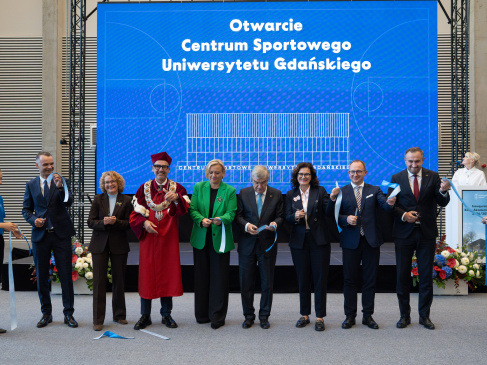
‘We have it!’ - with these words, the Rector of the University of Gdańsk, prof. Piotr Stepnowski, opened the University of Gdańsk Sports Centre. After more than half a century of waiting, the university has gained a modern and multi-purpose sports hall, which is intended to serve the entire academic community. And it was there, in this brand-new and…

science
Dr inż. Marta Chylińska from the University of Gdańsk has received a prestigious honour in the POLSIF Sustainable Finance Research Award competition. The award-winning publication, of which she is a co-author, concerns the behaviour of financial markets incorporating ESG criteria in conditions of heightened uncertainty.
The honoured publication,…

science
Dr Marek Rewizorski, prof. UG, has been honoured with a commendation in the Polish Society for European Studies (PTSE) competition for the best academic article in the field of European studies published between 2023 and 2025. The commended publication discusses the consequences of Russian aggression against Ukraine for the development of European…

science
On 17 and 18 September, at the Faculty of Biology of the University of Gdańsk, people will be able to take part free of charge in research conducted as part of the ‘Genomics for Poland’ programme. It aims to understand the genetic characteristics of the Polish population. Prof. Grzegorz Węgrzyn from the University of Gdańsk spoke on the ‘Radiowo-…

science
The University of Gdańsk has been ranked in the 51-75 bracket for Oceanography in this year’s edition of the Global Ranking of Academic Subjects (GRAS). This represents an improvement on its ranking of 76-100 in 2025 and 151-200 in 2024. The result confirms the gradual strengthening of the University of Gdańsk’s research position in this discipline.…

science
The Polish Patent Office has granted a patent to researchers from the Department of Plant Protection and Biotechnology and the Research and Implementation Laboratory of the Inter-University Faculty of Biotechnology at the University of Gdańsk and the Medical University of Gdańsk for a preparation designed to protect plants against diseases such as…

science
As part of the ICEPACT project (NAWA Strategic Partnerships), students from the University of Gdańsk and partner universities within the SEA-EU alliance can take part in student internships at the Chilean Antarctic Institute (INACH) in Punta Arenas (Chile) and in Antarctica, on Nelson Island (South Shetland Islands). The call for applications is open…

science
Researchers from the Faculty of Chemistry at the University of Gdańsk have patented a new oxovanadium(IV) coordination compound. The invention may find application as a precatalyst in the synthesis of polymeric materials - ranging from plastics with precisely engineered properties to materials capable of absorbing gases, which in the future may support…

science
fot. Tomasz Nowicki / MWB UG i GUMed
Prof. Danuta Gutowska-Owsiak from the Intercollegiate Faculty of Biotechnology UG and MUG has been awarded the EFIS Eastern Star Award 2026. This prestigious honour from the European Federation of Immunological Societies is awarded annually to just three scientists from Eastern Europe conducting…