Bone fractures are becoming an increasing health risk in a rapidly ageing society. In response to this challenge, the BONEFILL project was created, which aims to develop bioactive, injectable bone fillers that closely mimic the natural composition of bone, with the aim of accelerating the regeneration of small bone defects and reducing post-operative complications. The project is led by Dr Aneta Szymańska, prof. dr hab. at the University of Gdańsk, from the Department of Biomedical Chemistry, Faculty of Chemistry, University of Gdańsk. The project received nearly PLN 2.5 million in funding from the National Science Centre as part of the Weave-UNISONO competition.
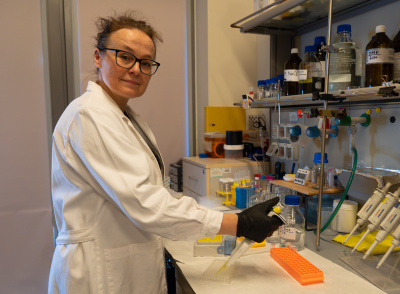
Prof. Aneta Szymańska in her lab
‘The problem of fractures affects, among others, seniors and people with hormonal disorders - age and hormonal factors affect bone density and increase the risk of osteoporosis. Current treatment methods often require repeated surgeries and the use of antibiotics, which leads to increased treatment costs and the problem of drug resistance,’ explains dr hab. Aneta Szymańska, prof. UG ‘The BONEFILL project proposes an innovative approach based on biomaterials that use hydroxyapatite, a natural component of bone, enriched with metal ions and peptides with antibacterial and bone growth-stimulating properties. The material will be placed in a biodegradable matrix of poly(glycerol) adipate or poly(sorbitol) adipate, and its mechanical strength will be increased by irradiation.’
The BONEFILL project will develop two types of fillers. The first is a composite hydrogel for non-surgical applications in small bone defects, and the second is an elastomer for external applications, which can be used during surgery and irradiated to achieve adequate stability.
The project will be carried out as part of the NSC Weave-UNISONO competition by an international consortium of scientists from the University of Gdańsk, Wrocław University of Technology, the Jozef Stefan Institute and the Faculty of Pharmacy at the University of Ljubljana. The combination of knowledge and experience will enable the effective development of a modern biomaterial that will improve the quality of life for many people, including the elderly, who suffer from bone fractures.
The expected outcome of the BONEFILL project is an advanced, injectable bone filler that promotes bone regeneration and minimises the risk of infection, representing a significant step forward in the field of regenerative medicine.