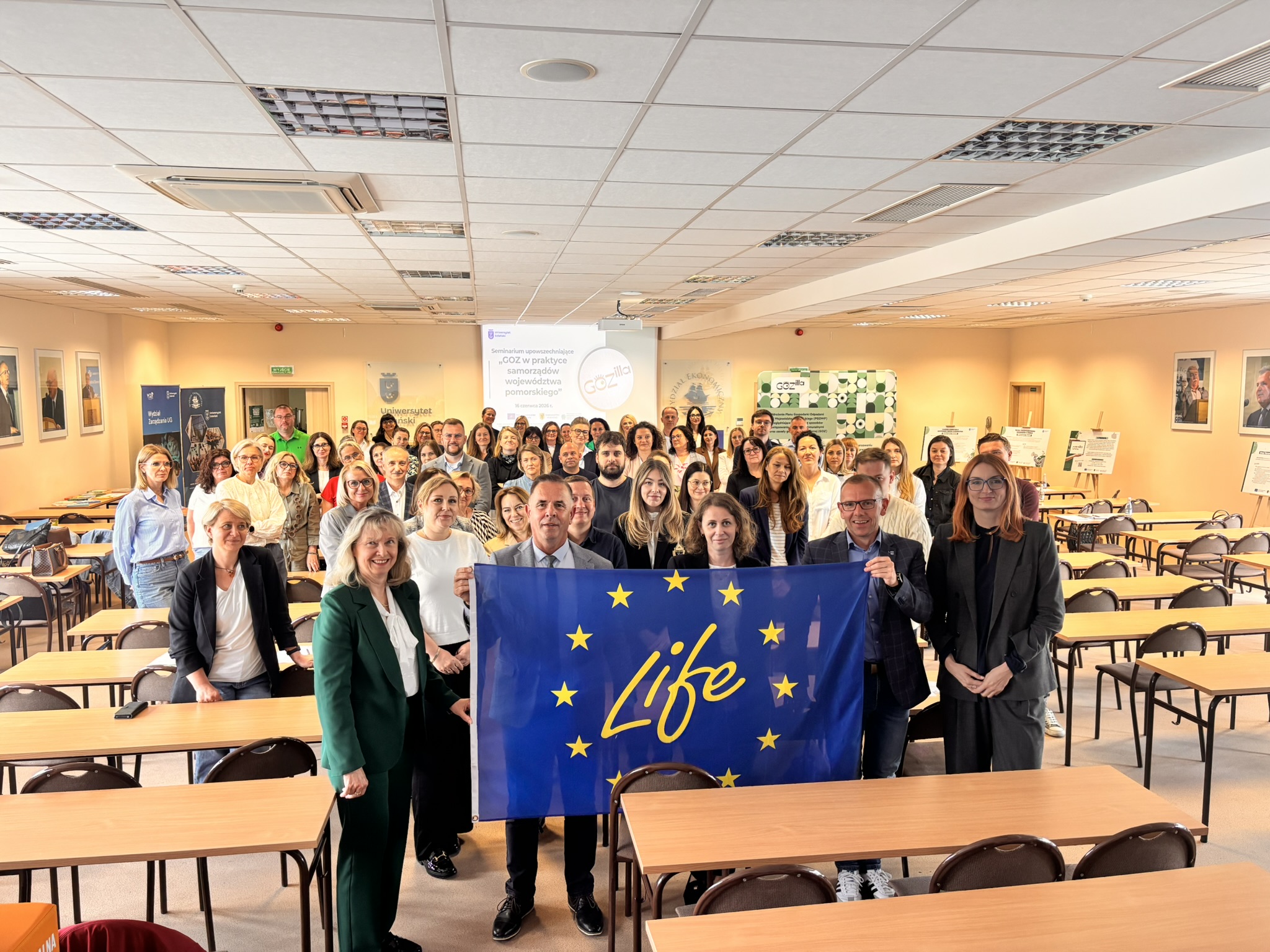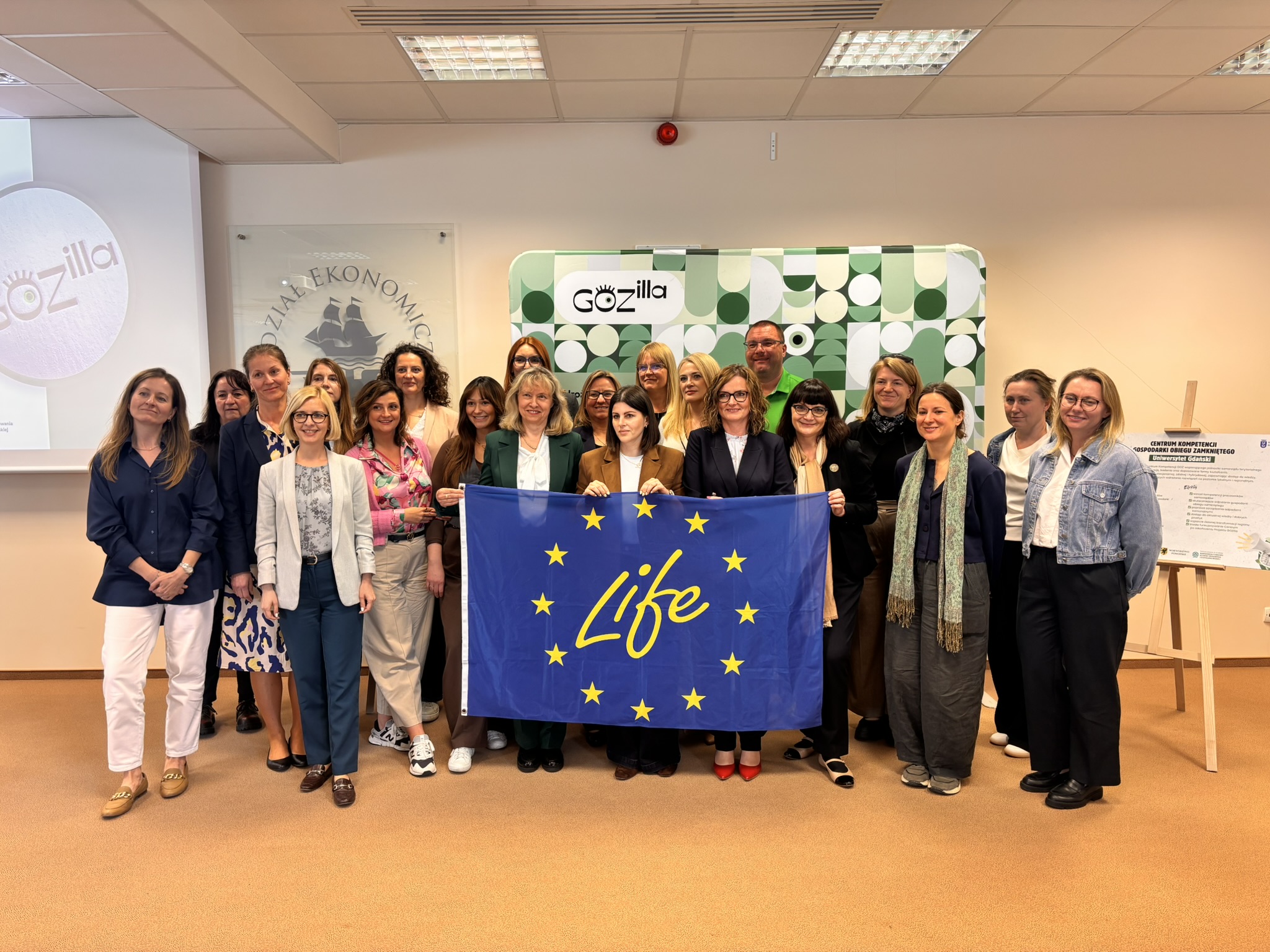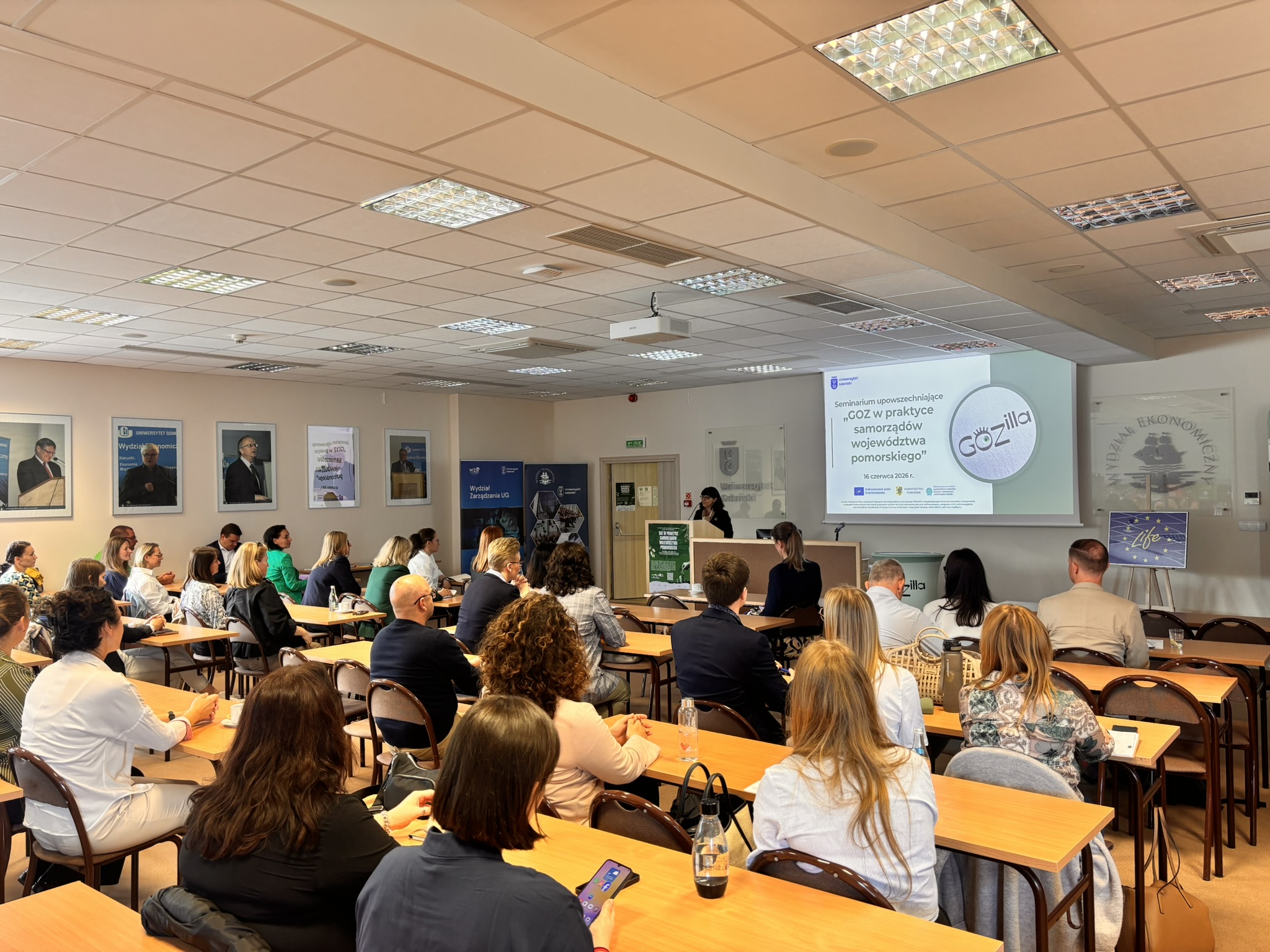
How can the circular economy be effectively implemented in local authorities in Pomerania? What are the biggest challenges facing local authorities, and what are the educational needs of officials and residents? Answers to these questions were the focus of the seminar ‘Circular Economy in Practice in Local Authorities of the Pomeranian Voivodeship’, which took place on 16 June 2026 at the Faculty of Economics of the University of Gdańsk in Sopot.
The event was organised as part of the LIFE Pom GOZilla.PL project, implemented by the Marshal’s Office of the Pomeranian Voivodeship and the project partners, thanks to funding from the European Union’s LIFE programme and the National Fund for Environmental Protection and Water Management.
The aim of the seminar was to present the findings of an assessment of waste management and the circular economy in the region, as well as the current state of knowledge and the educational and information needs of local authorities, and to discuss practical solutions supporting the implementation of circular economy principles in the Pomeranian Voivodeship.
The seminar was opened by the Project Manager on behalf of the University of Gdańsk prof. dr hab. Ewa Siedlecka and the Project Coordinator Paulina Górska, Deputy Director of the Department of Environment and Agriculture at the Marshal’s Office of the Pomeranian Voivodeship – the project leader.
Prof. Ewa Siedlecka emphasised the importance of cooperation between all partners involved in the project:
- I believe that the discussion surrounding the results we are talking about today will serve as inspiration for further action and the effective implementation of the circular economy concept across the Pomeranian Voivodeship.
Our activities are closely linked to your commitment. This cooperation is exemplary and demonstrates just how much can be achieved by combining scientific knowledge with local government practice,” she noted.
The necessary competencies and systemic support for local authorities
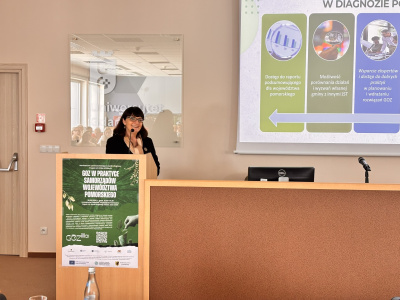
The first part of the seminar was devoted to the results of research conducted by the University of Gdańsk and the development of skills related to the circular transition.
The Vice-Dean for Development and Cooperation with the Socio-Economic Environment at the Faculty of Economics, University of Gdańsk, dr Magdalena Markiewicz, presented the results of a questionnaire-based survey on knowledge of the circular economy and its impact on the development of effective educational programmes in this field. The analysis showed that local government staff are open to developing skills related to the circular economy and recognise the importance of the circular transition for the development of their municipalities. However, there is a widespread need to establish systematic training support in the identified areas, as well as practical tools to facilitate the implementation of new solutions in the day-to-day work of the administration. Dr Magdalena Markiewicz also thanked dr hab. Sylwia Mrozowska, prof. UG, who participated in the seminar and initiated the project in collaboration with the Marshal’s Office.
New forms of education developed by the University of Gdańsk may provide a response to these needs. Dr hab. Anna Wojewnik-Filipkowska, prof. UG from the Faculty of Management at the University of Gdańsk presented the framework for the postgraduate programme “Circular Economy in Local Government Bodies”, which will be delivered as part of the project. Enrolment for the first intake will begin on 1 August and run until 13 September 2026. A total of six intakes are planned. The programme is aimed at employees of local authorities and their subordinate bodies. In addition, ten specialist workshops focusing on the practical aspects of implementing the circular economy will be organised each year. A detailed training programme will be published on the project website. Registration for the first training sessions is currently open (Training courses and webinars – GOZILLA).
A key part of the programme was the presentation of the findings of an assessment of the process and status of circular economy implementation in Pomeranian municipalities, delivered by Dr Piotr Sliż, prof. UG (Faculty of Management, University of Gdańsk) and Dr Magdalena Markiewicz (Faculty of Economics, University of Gdańsk). The study showed that over half of the municipalities analysed do not yet incorporate circular economy issues into their strategic documents. The most advanced area in terms of implementing circular economy principles remains the energy sector, whilst the greatest gaps relate to monitoring activities, strategic planning and intelligent resource management, including smart waste management.
The first part of the meeting concluded with a presentation of good practices from the municipality of Kartuzy. The Head of the Waste Management Department at Kartuzy Town Hall, Edyta Zientarska, and the Deputy Head, Natalia Lekner, presented the operations of the repair centre operating at the Kartuzy Municipal Selective Waste Collection Point
(PSZOK). The initiative helps to extend the lifespan of products and reduce the amount of waste entering the waste management system, serving as a practical example of implementing circular economy principles at a local level.
From diagnosis to action
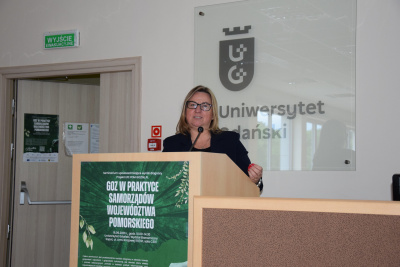
The second part of the seminar focused on further detailed solutions supporting the implementation of the circular economy in the region.
The Head of the Environmental Projects Department at the Marshal’s Office of the Pomeranian Voivodeship – the project leader – Kamila Szmidt presented the activities of the Marshal’s Office Support Centre. As she emphasised, the most significant challenges facing local authorities include difficulties in achieving the required recycling targets, reducing landfill, changing legislation, the need to provide effective public education, and the establishment and maintenance of municipal waste sorting centres (PSZOK). The Support Centre’s tasks include, amongst other things, providing free advice to municipalities and other local government bodies on municipal services and the implementation of the principles of the Circular Economy.
Representatives of the Pomeranian Regional Development Agency S.A., Małgorzata Zając and Natalia Kaliszewska, spoke about the communication needs of local authorities. The results of the analyses carried out show that effective communication requires a tailored approach to the specific characteristics of individual municipalities. As emphasised, there is no single universal model for an educational campaign that would work for all local government bodies. The speakers also outlined the objectives of the information and education campaign currently being prepared, the details of which will be presented in more detail in the near future.
The tourism sector also plays a significant role in building circular economy (CE) capabilities. Urszula Danowska from the Pomeranian Regional Tourist Organisation (PROT) presented the results of a needs assessment of businesses operating in the tourism sector. As she pointed out, businesses are becoming increasingly aware of the importance of the circular economy, but they lack practical implementation tools and expert support. The response to these needs will be a comprehensive education and implementation programme (the so-called ‘support pathway for SMEs’) currently being developed by PROT, comprising workshops, training sessions and webinars on the circular economy, ESG, sustainable tourism and generative tourism. The aim of these activities is to create models of tourism that not only minimise the negative impact on the environment but also contribute to improving the quality of the environment visited by tourists.
Another example of good practice was presented by Andrzej Sabinarz, chief specialist for securing supplementary funding for waste management activities in the municipality of Kaliska. Among other things, he outlined the operation of the local PSZOK, which plays a much broader role than simply serving as a waste collection point. The facility supports the reuse of materials, recycling and the delivery of educational activities promoting the circular economy.
The seminar concluded with a presentation by Dr Aleksandra Bielicka-Giełdoń from the Faculty of Chemistry at the University of Gdańsk on planned pilot initiatives relating to bio-waste. The first phase of the research is currently underway and will ultimately involve 120 households in the Pomeranian Voivodeship. In the second phase of the project, due to begin in 2030, 40 households will take part. The research findings are intended to provide the knowledge necessary to develop effective solutions supporting bio-waste management in the region.
The seminar demonstrated that an effective transition towards a circular economy requires close cooperation between the academic community, local government and partners from the socio-economic sphere. The results of the research point both to the growing readiness of local authorities in Pomerania to implement the principles of the circular economy and to the need for further development of skills, tools and support systems.
The LIFE Pom GOZilla.PL project
The project ‘Implementation of the Waste Management Plan for the Pomeranian Voivodeship (PGOWP), taking into account the hierarchy of municipal waste management methods and the principles of the circular economy (CE)’ is being carried out with funding from the European Union’s LIFE programme and from the National Fund for Environmental Protection and Water Management.
The main objective of the project is to create conditions in the Pomeranian Voivodeship conducive to the effective implementation of the provisions of the Waste Management Plan for the Pomeranian Voivodeship (PGOWP) with regard to sound municipal waste management, in particular the principles arising from the waste hierarchy and the principles of the circular economy, i.e. refuse, reduce, reuse, repurpose, recycle (5R: refuse, reduce, reuse, repurpose, recycle).
Project website – University of Gdańsk activities: GOZILLLA UG
Project homepage: GOZILLA Pomorskie.eu