
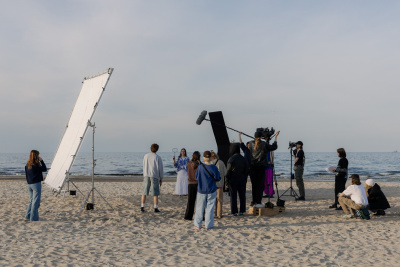
Since January 2025, the Andrzej Wajda Film Centre at UG has been operating under the auspices of the UG Academic Culture Centre ‘Alternator’. What does it do? What are its plans for further development? Anna Balkiewicz and Tomasz Pupacz tell us more.
The film zone of the UG Academic Cultural Centre ‘Alternator’ is expanding. In January 2025, the Andrzej Wajda Film Centre at UG began operating under the banner of the ACC, with its activities coordinated by the Deputy Director of the ACC, Tomasz Pupacz, and Anna Balkiewicz, a film production specialist.
‘It's a natural synergy. Thanks to the merger of the units, the ACC has an even richer offer. Our aim was to centralise the previously scattered film activities and create a place where they intertwine and reinforce each other,’ says Tomasz Pupacz.
The Academic Culture Centre's film section focuses on two main areas. The “Miłość Blondynki” Film Discussion Club has been operating for years, where students gain basic knowledge about how to organise film events and lectures, how to moderate discussions and how to design film festivals. And at the Andrzej Wajda Film Centre at UG, they can complement their film production skills. Both of these areas overlap, and both institutions offer student internships,’ says the Deputy Director of the ACC UG.
A small team, ambitious plans
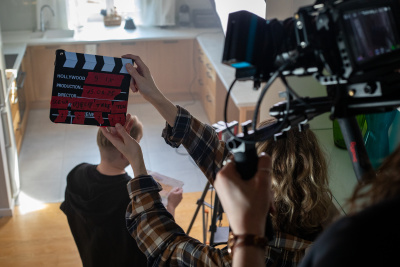
The film zone is coordinated by Tomasz Pupacz, and the Andrzej Wajda Film Centre at UG is coordinated by Anna Balkiewicz. Julia Kuster is involved in organisational and PR activities, while Paweł Cuper, a graduate of film studies at UG, is responsible for technical support and equipment rental. He also conducts training courses for students on how to use the equipment. In addition, directors Maciej Jarczyński and Jakub Poterała conduct practical classes with students. Their semester workshops include the production of a music video and a film animation.
Student film productions - a step into the future
Every year, the Andrzej Wajda Film Centre at UG organises a competition for funding for student film productions. On 23 February, this year's results were announced. ‘Every year, we introduce small changes that bring students closer to the procedures in force in national cultural institutions. The very process of applying for funding and preparing an application in our competition is educational for filmmakers who would like to apply for funding from institutions such as the Munk Studio, Regional Film Funds or the Polish Film Institute in the future,’ explains Anna Balkiewicz.
This year, 18 projects were submitted to the competition, 10 of which received funding. The committee consisted of: dr Piotr Kurpiewski from the Division of Film and Media of the Institute of Culture Studies, director Paweł Podolski, dr Grzegorz Fortuna-Skowron from the Division of Audiovisual Production of the Institute of Culture Studies, and Anna Balkiewicz representing the Andrzej Wajda Film Centre at UG. The competition budget was PLN 25,000. The highest-rated project was Oliwia Domańska's ‘Stupor,’ which received the highest amount of funding (5,100 PLN). ‘We realise that this is a small amount compared to film schools. Making a short film at a film school can cost thirty to forty thousand PLN. In addition, students there are provided with lighting, camera and sound equipment, cars, generators, fuel, as well as the support of technical staff: sound engineers, technical assistants and cameramen,’ says Anna Balkiewicz.
‘We are not a film school, but as part of the Film Centre, we offer students the opportunity to make their first films and gain their first experience in this field,’ explains Tomasz Pupacz. ‘The fact that these films are made on small budgets is a huge achievement for the students. You can see how much heart, energy and work they put into their projects and how many roles they play to make it all work.’
The Andrzej Wajda Film Centre at UG also offers equipment rental, and the range of equipment on offer is growing every year. ‘However, it should be remembered that if a film school has been operating for x years and has been receiving huge subsidies from the Polish Film Institute for years, its equipment capabilities are different from ours,’ explains the coordinator of the UG Film Centre. ‘However, we put a lot of energy into ensuring that our rental capabilities are constantly increasing.'
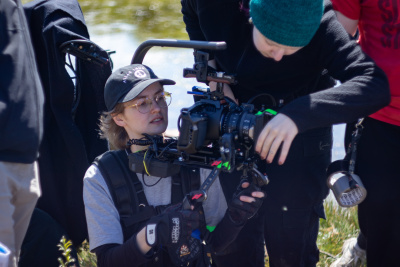
‘Film production is a collective effort. It consists of many different elements, which is why we are unable to predict certain things. The largest funding does not always guarantee the best results. That is why I would like to appreciate the creativity of young people and artists, because it is often the case that financial or logistical constraints trigger greater creativity and even allow for unexpected results,’ adds Anna Balkiewicz.
According to the competition rules, students can apply for funding amounting to 50% of the budget estimate. This means that they have to organise the other half themselves. ‘They obtain the remaining funds in various other ways, for example through crowdfunding. The ‘Stupor’ project on the crowdfunding platform has raised almost twenty thousand zlotys. And that was another argument for rating it so highly. There is a very high probability that the film it concerns will be made,’ says Tomasz Pupacz.
‘It is clear that the Stupor project is already largely organised in terms of production. The students already have a location in a monastery in Kazimierz Dolny and even accommodation for the film crew. These production elements usually come at a high cost, but the young filmmakers managed to organise them free of charge or in the form of barter,’ interjects Anna Balkiewicz, adding: ‘For those evaluating the application, these are signs that such a project has a much better chance of being realised. In addition to a very good application and cost estimate, we received all the documentation, both for the locations and the selection of the venue, with ideas for the scenes to be shot there, as well as beautiful mood boards, costume concepts and set design ideas. All this, together with the script, which also stands out, indicates that this project will be implemented. We see enormous potential in this project.’
The main character of the film ‘Stupor’ is Lena, who comes to a monastery to shoot a reportage about a miraculously healed woman, but when the woman loses her sight again, Lena begins to film her secretly, unknowingly turning her journalistic material into a personal story.
‘Even at the proposal stage, this film stood out. It is clear that this is not a project written for a competition or for funding, but that it is well thought out and very well written,’ says Anna Balkiewicz. ‘The consciously constructed characters in this story deserve attention. Lena, a journalist from a big city, is modelled on Agnieszka from Andrzej Wajda's films, so she is a confident, independent woman who seeks the truth. Natalia, with her faith and gentleness, and above all her unwillingness to convince anyone of anything, simply shows Lena the part of life that she, in her pursuit of success, loses sight of. The story is written in a delicate, unpretentious and unobtrusive way. It is clear that the script has been well thought out.’
Filming for Stupor is already underway. So is the preparation of the relevant documentation and production work for the nine other co-financed projects. ‘We are keeping our fingers crossed for the completion of all ten productions. It is worth noting that the experience so far has been very positive. In last year's competition, all fifteen projects were completed and settled. We are very pleased that the students are taking this opportunity very seriously,’ says Tomasz Pupacz.
Student Film Festival, new studio, and workshops
For many years, the UG Library has housed a Film Studio, where trainees can work on joint film projects under the watchful eye of experienced filmmakers. Soon, they will be able to present them to a wider audience during the 10th anniversary edition of the Cinerama Fest Student Film Festival, which will take place in autumn 2026. This is an opportunity to see what young people - students of the Fahrenheit Union of Universities in Gdańsk (University of Gdańsk, Gdańsk University of Technology, Medical University of Gdańsk) and the Academy of Fine Arts in Gdańsk - are interested in.
‘This year, as part of the festival, a series called Krótkie szorty (Short Shorts) was launched, which will present films by students of our university. The series will be broadcast nationwide. So it will be an additional opportunity to present their work to a wider audience,’ says Tomasz Pupacz.
The Andrzej Wajda Film Centre at UG plans to launch a Film Animation Studio, intended not only for students of the University of Gdańsk, but also for students from Tri-City art universities. Already in April, there will be weekend animation workshops for all interested parties, led by Maciej Jarczyński - an independent filmmaker, visual artist, animated film creator, graduate of the Gdynia Film School and, worth noting, a graduate of film studies at the University of Gdańsk.
Anna Balkiewicz and Tomasz Pupacz agree that the Andrzej Wajda Film Centre at UG is not a film school, and that the courses in Film and Audiovisual Culture and Audiovisual Production are taught at the Faculty of Languages. ‘We work closely with students and lecturers teaching both courses. In addition, the Film Centre has an expert team consisting of our employees and employees of the film programmes at the Faculty of Languages. We are opening up more to the local film community. This gives us the opportunity to exchange experiences and jointly create a programme concept that meets the needs of students,’ admits Tomasz Pupacz.
‘We are also working on introducing changes to our website in order to give more exposure to the students' work. We plan to include information about all of last year's films, along with stills from them and ‘making of’ materials, adds the coordinator of the CF UG.
‘We want the Film Centre's website to become a kind of exhibition space for student films. We want to make it easier for young filmmakers to get started so that they can work on their portfolios from the very beginning of their studies,’ says the deputy director of the ACC.
There is a lot going on in the film section of the UG Academic Cultural Centre “Alternator’, and the offer is constantly expanding with new additions. One of them is the English-language Film Discussion Club, or Movie Break, which meets on the last Tuesday of every month. A film podcast, which a team of students is working on, will soon make its debut.
‘Students are very interested in film studies. People have a lot of energy to act. We are optimistic,’ admits Tomasz Pupacz.
New headquarters with an arthouse cinema and multimedia studio
‘We are also hoping that the script – this time not a film script – will come true and that in a few years' time we will meet in the new headquarters of the Academic Culture Centre. If the project comes to fruition, the film zone will gain a really large space to operate in. The plans include an arthouse cinema and a professional multimedia studio where students will be able to gain practical knowledge,’ says Tomasz Pupacz. The first visual design is to be created in a few months.
‘This year, we are celebrating the 45th anniversary of the ACC. So it's a great opportunity to announce the changes that await the academic community. We still have the most difficult road ahead of us, which is to obtain funding for this investment, but after the Sports Centre, there must be a cultural centre,’ adds Tomasz Pupacz.
Artificial intelligence and the cinema
Are Tomasz Pupacz and Anna Balkiewicz not afraid that with the development of artificial intelligence, the creative industries will be deprived of work and the cinema will lose its magic?
‘In the history of cinematography, almost every technological leap heralded the end of the cinema, but this never happened. Jean-Luc Godard said that cinema will never end, and I also support this theory,’ comments Anna Balkiewicz.
‘Many cultural phenomena are sinusoidal in nature. At first, there is enthusiasm, and then a decline. This was the case with streaming. It was said that people would stop going to the cinema, but this did not happen. At some point, viewers returned to the cinema because the experience of watching a film together is irreplaceable. Our activities, both at the DKF and at the Film Centre, show that people want to meet, come to films and discuss them. We also focus on practice. We want to be able to work on film projects together, person to person, and not just online or using artificial intelligence,’ concludes Tomasz Pupacz.