
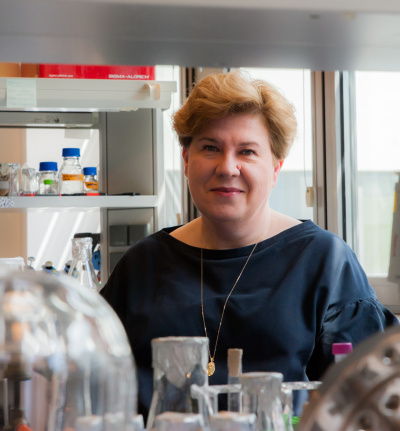
The University of Gdańsk has secured significant funding of PLN 11,697,052 for the implementation of a groundbreaking research and development project entitled ‘Enzymatic composition for combating infections and bacterial biofilm present in a patient’s catheter and bladder’. The project was selected as part of the TRANSMED I competition (ABM/2024/8) organised by the Medical Research Agency, which aims to support innovative solutions in the field of translational medicine. The project leader is Prof. Alicja Węgrzyn, Director of the Phage Therapy Centre at the University of Gdańsk and an expert in bacteriophage biology.
Prof. dr hab. Alicja Węgrzyn, together with a team of researchers from the Faculty of Biology and the Faculty of Chemistry at the University of Gdańsk, will develop an innovative enzymatic composition with clinical potential.
The project aims to create a library of enzymes and peptides with antimicrobial activity, including, among others, phage depolymerases, endolysins, peptidomimetics, and synthetic and natural antibacterial peptides. A key element of the research will also be the development of fusion enzymes capable of permanently binding to the surface of catheters, enabling their localised and long-lasting anti-biofilm action.
Two research teams are involved in the project: one from the Faculty of Biology (dr hab. Bożena Nejman-Faleńczyk, prof. UG, and dr hab. Magdalena Płotka, prof. UG) and one from the Faculty of Chemistry (the teams led by prof. dr hab. Sylwia Rodziewicz-Motowidło and prof. dr hab. Piotr Skowron).
Why is this project so important?
‘Urinary tract infections are among the most common bacterial infections worldwide, and patients requiring long-term catheterisation are particularly at risk,’ explains prof. Alicja Węgrzyn. ‘The bacterial biofilm that forms on the surface of catheters poses a huge clinical challenge, as it significantly hinders treatment and promotes the development of antibiotic-resistant bacteria and numerous recurrent infections. Currently available methods of prevention and treatment are not sufficiently effective, which is why it is necessary to seek new therapeutic solutions. Our project addresses one of the most important contemporary challenges in medicine: the fight against antibiotic resistance and hospital-acquired infections.’
The project involves extensive biological activity testing on over 200 clinical bacterial strains, as well as stability studies, optimisation of operating conditions, and testing on in vitro and in vivo models. The most promising formulations will be prepared in accordance with GLP standards and subjected to further evaluation in laboratory animal models prior to any clinical trials.
Planned project outcomes
The expected final outcome of the project will be the development of a prototype enzymatic formulation that effectively eliminates bacterial biofilm from the surfaces of catheters and from patients’ bladders, as well as preventing its reformation. At a systemic level, the implementation of such a solution will contribute to shortening hospital stays, reducing the number of complications and lowering treatment costs, which is in line with the European Union’s strategic public health objectives.
‘We hope that the project will result in the creation of a globally innovative, effective and safe solution that limits the growth of bacterial biofilm in patients requiring short- or long-term catheter use. I very much hope that the enzymatic composition developed as part of this project will help reduce the number of hospital-acquired infections, limit the use of antibiotics and counteract the growing problem of antibiotic resistance,’ says prof. Alicja Węgrzyn.
In the context of the growing problem of catheter-associated infections in short- and long-term hospitalisation and the increasing antibiotic resistance of bacteria, the implementation of this project may be of significant importance to modern medicine. The University of Gdańsk’s success in the TRANSMED I competition is further proof of the university’s strong position in the field of biomedical research and its active role in developing innovative technologies with high implementation potential.
Project duration: 1 July 2026 - 30 June 2029.