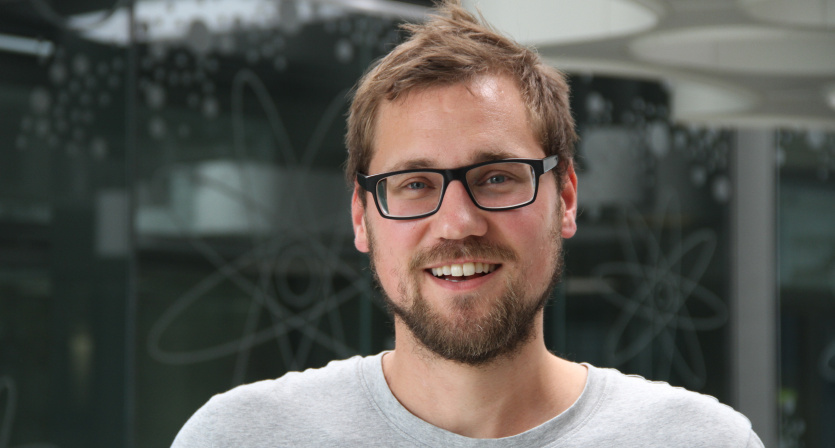
Dr Felix Huber from the Institute of Computer Science at the University of Gdańsk was among the winners of the prestigious international QuantERA Call 2025 grant competition, having been involved in two projects, one of which he will coordinate. The competition is one of the most important European programmes supporting research into quantum technologies.
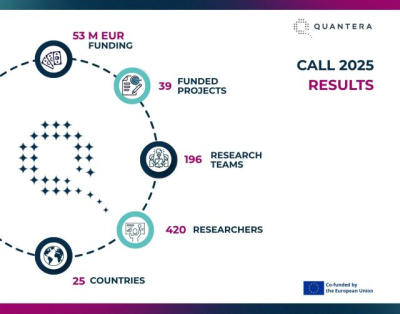
In the QuantERA Call 2025 competition announced by the National Science Centre, 39 winning projects were selected from a record number of 287 applications submitted by research teams from across Europe. Among the seven projects involving Polish scientists, there were as many as two initiatives associated with the University of Gdańsk.
The greatest success is securing funding for the project SDPCode - “Semi-definite foundations of quantum codes: convergence, constraints, and constructions,” whose international coordinator is dr Felix Huber from the University of Gdańsk. The project will be carried out in collaboration with research teams from France, Germany, and Slovenia. Its goal is to develop the mathematical foundations of quantum codes, which are one of the key elements in building future error-resilient quantum computers.
Dr Felix Huber is also participating in a second funded project: ToDiQT (“Towards Device-Independent Quantum Technologies”), carried out jointly with partners from Austria, Belgium, and France. The research will focus on developing methods for certifying quantum devices, secure quantum cryptography, and verifying computations performed by quantum computers.
‘Quantum technologies are recognised today as one of the pillars of the future knowledge-based economy. They can find applications in sectors such as telecommunications, defence, and space. Countries and regions that are already investing in quantum research are building a competitive advantage for decades to come. That is why the success of researchers at the University of Gdańsk is significant not only for the advancement of science, but also for the innovation of Europe’s economy and technological security,’ emphasises the UG Vice-Rector for Research, prof. Wiesław Laskowski.
Dr Felix Huber is an assistant professor at the Institute of Computer Science at the University of Gdańsk. Before coming to Gdańsk, he led the Quantum Information and Computation research team at the University of Bordeaux in France and the Quantum Error Correction research team at Jagiellonian University.
He also gained experience during postdoctoral fellowships at renowned European research centres, including ICFO in Barcelona and the University of Cologne. His doctoral dissertation was honoured with the prestigious Dissertation Award of the German Physical Society. Since 2024, he has served as an editor of the international scientific journal “Quantum” and in 2025 was a member of the program committee for the Quantum Information Processing (QIP) conference, one of the most important events in the global community of quantum technology researchers.
His research interests include quantum error correction, quantum computation theory, quantum entanglement, nonlocality, quantum communication, and the mathematical foundations of quantum information processing.
‘In the case of Felix Huber’s project, it is particularly worth noting that his research on quantum error correction addresses one of the greatest challenges facing the construction of quantum computers. Without effective error correction, quantum computers will not be able to perform complex calculations reliably; therefore, progress in this field is crucial for building scalable quantum systems with real scientific and industrial applications,’ adds Vice-Rector prof. Wiesław Laskowski.
The fifth edition of the QuantERA competition was announced by 34 research funding agencies from 29 European countries. The program supports projects addressing both fundamental quantum phenomena and practical applications of new technologies.
As emphasised by prof. Konrad Banaszek, scientific coordinator of the QuantERA program, the record number of applications confirms the tremendous momentum of the European quantum technology ecosystem. Projects funded under the call are intended to strengthen Europe’s position in the global race to harness the potential of the so-called second quantum revolution.
Research conducted by international consortia will focus, among other things, on the development of quantum computers, secure communication, modern sensors, and imaging methods that may find applications in medicine, industry, and new digital technologies in the future.
Dr Felix Huber’s website: https://huberfe.github.io/
Information on the competition results on the National Science Centre website: read here