
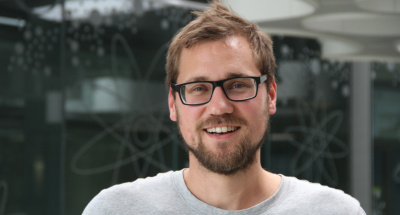
What do an unsolved Sudoku puzzle, a scratched CD, and a quantum computer have in common? Which quantum technologies are likely to begin transforming our everyday lives within the next decade? And does Poland have a chance to become one of the leaders of the second quantum revolution? We spoke with dr Felix Huber from the Institute of Computer Science at the University of Gdańsk, a recipient of two grants awarded under the QuantERA Call 2025 programme. He will serve as the international coordinator of one of the projects.
Urszula Abucewicz: - You have become a laureate of two QuantERA projects at the same time. What does this success mean to you?
Dr Felix Huber: - These two projects are a great opportunity to solidify international collaborations, while also giving a boost to the quantum ecosystem in Gdańsk and Poland generally. On the personal level, it is exciting that my team is given the chance to pursue our research ideas.
- You are the international coordinator of the SDPCode project, which will be carried out in collaboration with research teams from France, Germany, and Slovenia. The project focuses on quantum error correction. How would you explain the idea behind SDPCode to someone without a background in physics or mathematics?
- An error correcting code is like an unsolved Sudoku: one can fill in the whole square starting from only a few given numbers. This idea is used for storing and submitting information - so that the music CD still plays fine even with some scratches on it, and the phone call goes through with only one bar of reception. The idea of SDPCode is to understand the limits of quantum error correction: How many 'bars of reception' does my quantum computer need to still function?
- Could your work help bring us closer to large-scale, fault-tolerant quantum computers? What would constitute a major breakthrough for this project?
- A major breakthrough would be to find a method that allows us to easilly construct good quantum codes that are adapted to concrete experimental platforms. That would be a great step towards large-scale, fault-tolerant quantum computing.
- The title of the second project in which you are involved is certainly intriguing: ToDiQT ('Towards Device-Independent Quantum Technologies'). In practical terms, what does the concept of 'device-independent quantum technologies' mean?
- Device-independence refers to a way to make sure that there is no backdoor to encryption that is based on quantum systems.
When using quantum systems for encryption, we want their security to be independent of the exact physical realisation of the quantum device. This can be done via certain statistical tests which make use of features that can only be found in quantum systems. These tests then give us safety guarantees that are stronger than those that can be obtained using only classical computers.
- Many people compare quantum technologies to the early days of classical computing. Do you think this comparison is accurate?
- In some sense, yes, but there are also notable differences. Classical computing had a much longer development time. It started with analog computers that roughly resembled mechanical watches before transitioning to digital computers run on electric currents. The development of quantum computing is somewhat faster as we can rely on a whole field of study that was created since: Computer Science. That makes the progress of our theoretical understanding much faster. A second accelerator is the expectation that quantum computing will be a transformative technology, so the investments are much larger.
- What quantum applications are most likely to reach society within the next decade?
- Most likely quantum metrology. This allows measuring physical quantities (for example, the gravitational field or time) more accurately with quantum systems.
- The projects bring together partners from several European countries. What advantages does this international collaboration provide?
- Science rests heavily on the exchange of ideas, and the most efficient exchange happens when people discuss. International meetings are very important to spread the best ideas across borders. Having a consortium makes this exchange more robust.
- Can Poland become a significant player in quantum technologies?
- Poland has great potential. Many pioneers of quantum information science are from Poland, the country has a community of outstanding researchers, and it is increasingly attracting talented scientists from abroad.
Thus, access to top talent is there. What is not competitive is the bureaucracy, which, for Poland to be a top player, needs a major overhaul.
Finally, a sustained investment in both theoretical and experimental research, the creation of attractive career opportunities to attract and retain talent, and the support for programs that help translate scientific breakthroughs into practical technology are required.
- What attracted you to quantum information science?
- It is a young and fast-developing field where physics, computer science, and mathematics meet.
That makes it an exciting scientific playground.
----------------------------------------------------------------------
Dr Felix Huber is an assistant professor at the Institute of Computer Science at the University of Gdańsk. Before coming to Gdańsk, he led the Quantum Information and Computation research team at the University of Bordeaux in France and the Quantum Error Correction research team at Jagiellonian University.
He also gained experience during postdoctoral fellowships at renowned European research centres, including ICFO in Barcelona and the University of Cologne. His doctoral dissertation was honoured with the prestigious Dissertation Award of the German Physical Society. Since 2024, he has served as an editor of the international scientific journal “Quantum” and in 2025 was a member of the program committee for the Quantum Information Processing (QIP) conference, one of the most important events in the global community of quantum technology researchers.
His research interests include quantum error correction, quantum computation theory, quantum entanglement, nonlocality, quantum communication, and the mathematical foundations of quantum information processing.