
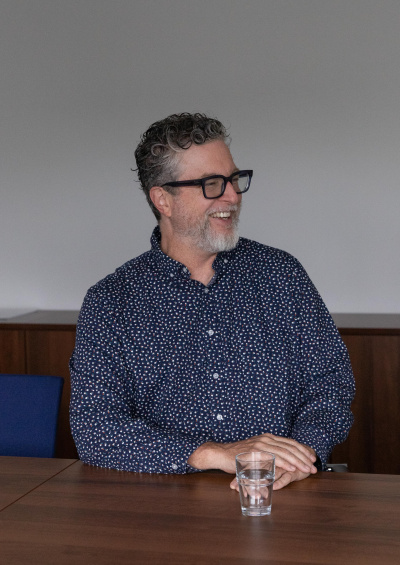
Do Europeans have an interesting perspective to offer in American studies? How many hours does it take to drive from one end of Texas to the other? We talk about the humanistic values of higher education, the university as a space for dialogue that is the foundation of democracy, and how high tuition fees affect the way students study with prof. Randolph Lewis from the University of Texas at Austin, who visited the University of Gdańsk as part of the ‘UG Visiting Professors’ programme.
Dorota Rybak: - Your main research interest is surveillance technology and current politics, isn’t it?
Prof. Randolph Lewis: - I have been a scholar of American Studies for 30 years now. I've written about a lot of different things. The last book I did was on surveillance technology and how important it is in shaping the world we live in. Before that, I wrote about Native Americans in the United States. And right now, I'm working on a book of essays about contemporary politics and culture in the United States, where things are very strange.
- What did you work on during your stay in Gdańsk? This is also the question for you, Professor Misztal, as you are the spiritus movens behind the visit.
Dr hab. Arkadiusz Misztal, prof. UG: - Ok, so let me start. I invited Professor Randolph Lewis to visit us as a visiting scholar but also to take part in the conference Metamorphoses of Time that we’ve organised in Gdańsk. At the conference, Professor Lewis gave a talk on Tesla time. This was his first exposure to our university and our academic life. Next week, he delivered a most interesting lecture based on his forthcoming book, Bummerland. There were faculty members and students present, and we had an intense Q&A session. We also had another meeting with the faculty during which we discussed how we can improve our teaching programs, how we can make them more attractive, and how we can develop new research interests in the field of American Studies.
- Professor Lewis, what is your impression of Polish students?
R.L.: - Well, I would say first of all that I've been really impressed with their sophistication and their engagement. They have been very willing to jump into the discussion and ask hard questions, frankly. I've been really delighted.
It's a different academic culture here. I have some very good students in Texas. But I feel like they're doing too many different things at once to be focused on their studies; or they're just focused on a professional degree, and so they're not really interested in history, culture, and language; they're just trying very quickly to get to the finish line and get a job. And I understand that makes total sense, but it's different than it was in America 20 or 30 years ago, when students could take four or five, even six years to graduate. That extra time meant that they could study in another language just because they were interested or get a second major.
- What has changed?
R.L.: - The economic pressure, in terms of the cost of tuition, which is very high even at a state university, combined with that need to get a job, makes it less likely for American students to explore right now. And so I was really appreciative of your students. I know that most of them have jobs and are working hard as well, but I felt like there was a real spirit of curiosity about ideas and about the United States that I don’t always see at home.
- You mentioned the cost of tuition. Full-time higher education is free in Poland, so you don't pay tuition to a public university like our own. But many people try to push the idea that it should be privatised, it should be paid for with normal tuition fees, to provide better engagement from the side of students. And the United States is always given as an example of a place where it works really well. You don’t seem to agree that paying tuition increases students’ engagement.
R.L.: - No. When I went to the University of Texas, I was a first-generation college student from a blue-collar family. The state's support was very high for public higher education in America up until the 1980s, when it started to change. College wasn't free, but it was maybe three hundred dollars every semester, and that meant my family could afford to support me for seven years in school to become a professional.
Right now, in America, state support has been withdrawn to a considerable degree. The tuition at the flagship University of Texas in Austin is - with fees and everything - $20,000 or $25,000 for tuition in one year; you know, it's an enormous amount of money for people that are not wealthy. And so what happens is that you don't have public education that transforms the citizens from any background into something new. You only get a public education that takes the wealthy and prepares them to continue to be wealthy intergenerationally. That's the problem right now in America. American education has become more and more expensive, and the working-class and poor students are unable to access high-level education unless they're very lucky and get certain scholarships. The quality of education is high in the U.S., of course, but it is no longer accessible to everybody.
I can add that these sorts of pressures are present now at our university. Right now, BA students, undergrad students, they all work up to 30 hours a week to pay the bills. They do not have as much time as they used to have for leisure and for some other activities, like after-school clubs, science clubs, or conferences.
- Is there anything else high tuitions have impact on?
R.L.: - It also changes what you can study - because everything has to become practical. You might have a passion for art history or philosophy, but how can you go $100,000 in debt to study philosophy or study languages? Law schools in America know that the best students are philosophy majors, both in terms of their LSAT score and their performance in law school. But you're not going to produce a lot of philosophy majors in an educational context that is so expensive that students have to rush for the exit as soon as they can, and then they're still in debt. I don't know if it is fully appreciated in Poland how much debt American students carry for their whole lives. It's just crushing. It’s one of the reasons they're not able to buy houses like they could up until the 1980s and 1990s. Young people feel like they're never going to buy a house, often because they have $150,000 in student loans that they're paying off for the next 20 or 30 years. If Poland can avoid that somehow, I think it's so much healthier for the society in the long run. Not to mention the fact that Poles have a natural affinity for ideas and education, history and culture. It’s clearly a culture that values education.
- Was there something that surprised you about what our students or scholars know or do not know about the U.S. or Texas?
R.L.: - Well, none of the students had been to Texas, so that's all new to them. And Texas is so big that it is difficult to convey its essence. Imagine this: it takes 23 hours to drive across Texas at top speed! It's very urban and sophisticated in certain ways, and then there are ranches, and farms, and logging woods, and desert. It's just a very diverse place, and that's something I'm trying to share with the students because I don't think they're aware of that, having not been there.
But the really fascinating thing is I was showing them a film that I made about apocalypse culture in the US. Before watching, I asked my class if they think America is dystopia or utopia in 2025? I have like 14 or 15 people in the class, and every single one of them said dystopia because we don't have strong support for education, we don't have health care unless we have a job, and we have gun violence that is unpredictable - there is an enormous amount of random mass violence. So, you know, there are many exciting things about living in America, but those negatives are so strong. And the instability in the whole system that the current administration is causing makes it a difficult place, I think, for any kind of dreams, let alone utopian dreams. But it still is sobering as an American to hear that European young people are thinking that America's passed its best moment and the more exciting future is either here, Scandinavia, New Zealand and other places that they were talking to me about. I love that kind of conversation, but it would be shocking to most Americans. Because the average American believes that they really live in a divinely approved, special, exceptional nation that, you know, God loves the best - even if they don’t have health care or access to higher education.
- What - in your opinion – is the main value of the university education, apart from the practical aspects?
R.L.: - As somebody who didn't come from a family that had gone to college, I see it as a sacred space. The university is a space where we have the ability to explore questions and disagreements in a civilised and civil manner, and that's not something that we see in American politics anymore or in our media, where one side is yelling at another. The classroom in America is one of the last places where you can talk about hard topics without yelling. There's a great quote from the American philosopher John Dewey, who said, 'Democracy begins in conversation.' And I think that's true. Americans have sorted themselves by political affiliation in terms of where they live to a very high degree now. So Republicans live in one area, and Democrats live in another. That was not true when I was growing up in the 1970s and 80s. And so, as a result, those conversations - those that make a democracy - are not happening, and it's much easier to demonise and dehumanise the other side. My family is very politically conservative. I am not. But I love them, and I try to understand them. And this is one of the great lessons, I think, of the humanities in higher education. Education helps people develop a sense of sociological empathy as well as historical empathy.
- I also wanted to ask you, an American scholar specialising in American Studies, if the Europeans, as outsiders, can offer some research perspective that is valuable also for Americans?
R.L.: - Oh, without question! We have colleagues in Finland who come every few years to study the gun problems that we have. I hope we can develop a similar kind of relationship with the University of Gdańsk. And because you have different norms, different experiences, you can see things in a different way. In the case of the Finnish scholars, they can come and look at just how strange Texas gun laws are with that kind of healthy outsider perspective. I welcome that. And I think that international collaboration is definitely the most interesting part of my academic life. I taught in Italy for a year as a Fulbright scholar, and I learned so much from my Italian colleagues about how they thought of things and how they thought of America.
Honestly, if I could do anything to fix America right now, I would start a fund so that every American college student could have a year of study abroad. It would be so transformative! I see how it transforms students out of a provincial, narrow worldview. I see the students of mine who have studied in Europe or elsewhere, and it just changes them so much. I think this is a very, very important point. If students are allowed to study abroad, even for a short period, that completely changes their experience. And unfortunately, it is not that easy for American students to go to Europe and spend some time here.
- Thank you for the conversation!