

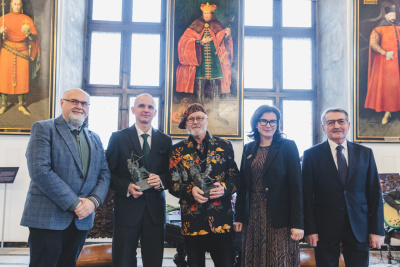
Prof. Michał Horodecki from the International Centre for Theory of Quantum Technologies (ICTQT UG) has won the Jan Hevelius Science Award of the City of Gdańsk for 2025 in the category of natural and exact sciences. ‘Jan Heweliusz was a symbol of knowledge and a man who looked at the sky not just to look, but to discover what we cannot name. Today's winner displays exactly the same attitude. A consistent, creative, uncompromising attitude of seeking scientific truth and openness to new challenges,’ emphasised prof. Grzegorz Węgrzyn, President of the PAS Branch in Gdańsk, in his laudation.
The Jan Hevelius Science Awards of the City of Gdańsk, known as the ‘Gdańsk Nobels’, have been presented for 39 years.
The winner of this year's Award in the natural and exact sciences category was prof. dr hab. Michał Horodecki, and in the humanities and social sciences category - prof. dr hab. Tomasz Bogusławski from the Academy of Fine Arts in Gdańsk.
The Jan Heweliusz statuettes, designed by prof. Jan Szczypka, were presented to the award-winning professors by the Mayor of Gdańsk, Aleksandra Dulkiewicz, who said: ‘Thank you, professors, for your hard work, which makes our lives better, smarter and more beautiful. For educating future generations, because science and art cannot exist without successors. Finally, for promoting Polish talent in Gdańsk. Finally, my wishes. Physics proves that there are two types of friction: static and kinetic. I wish our laureates, with unwavering enthusiasm, to continue to devote themselves to kinetic friction as fruitfully as they have done so far, even though they could rest on their laurels and rub only statically. Long live Gdańsk science and art. Vivat!’
The laudation for prof. Michał Horodecki was delivered by prof. dr hab. Grzegorz Węgrzyn, who, emphasising the laureate's outstanding scientific achievements, recalled his groundbreaking scientific works, which were an ‘intellectual shock’:
‘In the history of science, there are special moments, moments when someone formulates an idea so accurate, so universal, that it immediately becomes the new language of an entire discipline. Such a moment took place in 1996. It was then that Michał Horodecki, then a student, together with Ryszard Horodecki and Paweł Horodecki, co-authored a paper on the general theory of quantum entanglement. Quantum entanglement could be described as a magical bond between particles. In reality, it is a fundamental phenomenon - a way in which nature allows information to be combined in a way that is impossible to achieve in the classical world. It is difficult to imagine what is happening in these quanta. But it was an important foundation for future quantum computers, quantum historiography and ultra-sensitive measurements.’
Prof. Grzegorz Węgrzyn recalled the laureate's other achievements that broke new ground. He mentioned his publication in the journal Nature, written in collaboration with prof. Jonathan Oppenheim and prof. Andreas Winter, on the subject of so-called negative quantum information.
‘For most of us, information is something you can have more or less of. However, it turns out that in the quantum world, the concept of information can be more subtle,’ he noted.
‘It is moments like these that push civilisation forward. Great universities stand out because, at the right moment, they take the risk of entering new territory where there is no well-trodden path yet,’ emphasised prof. Grzegorz Węgrzyn. ‘Professor Michał Horodecki is undoubtedly a scholar of outstanding international standing. He is the author of works that have not only been noticed, but have become points of reference for physics.’
‘Jan Heweliusz was a symbol of knowledge and a man who looked at the sky not just to look, but to discover what we cannot name. Today's laureate displays exactly the same attitude. A consistent, creative and uncompromising attitude of seeking scientific truth and openness to new challenges,’ concluded the laudator.
Prof. Michał Horodecki, thanking for the award, emphasised the influence of his immediate family on his scientific passion: ‘I am not someone who has reached this point on my own, by my own efforts. I was carried by my surroundings - by my family home.’
The winner of the ‘Gdańsk Nobel’ also thanked prof. Robert Alicki, whom he called a genius, and his wife, dr hab. Magdalena Horodecka, prof. UG, who is a scholar of contemporary literature. ‘Art has always been appreciated in my family home, which is why my wife and I get along so well. And the fact that my wife is a scientist means that we understand perfectly what it is like to live with a scientist. Thank you very much, Magda. For the whole beautiful family,’ he emphasised at the end.
We warmly congratulate the professor!


