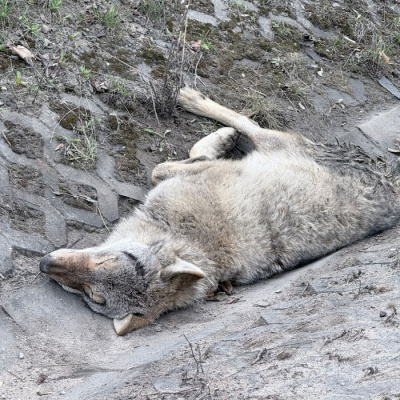
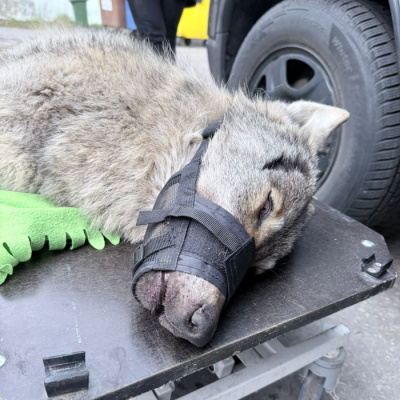
On Thursday, 26 March, a car struck a young female wolf near the Tricity Ring Road. Scientists from the Department of Vertebrate Ecology and Zoology at the University of Gdańsk took part in the rescue operation aimed at helping the animal. We spoke to dr Maciej Szewczyk about encounters with wolves, rescue operations, and the myths surrounding these predators.
Karolina Żuk-Wieczorkiewicz: - I understand that as the wolf population grows, so does the risk - or the chance - of encountering this predator.
Dr Maciej Szewczyk: - That’s true, but direct encounters are still rare. Spending several dozen days a year in the forest tracking wolves, I usually have 1-2 direct sightings a year, and these encounters last only a few seconds.
- How should one behave if one comes across a wolf? And what should one absolutely not do?
- Usually, there’s no time to think about what to do, as the wolf disappears quickly. In the rare instances of longer encounters, if you feel uneasy, it is best to say something out loud (but do not shout) - wolves have poor eyesight and may not realise they are dealing with a human, but they almost always react by fleeing at the sound of a human voice. You should neither run away nor approach the predator.
- On Thursday, you were called out to intervene following a wolf being hit by a car. What was your role?
- A four-person team from our department went to the scene: Małgorzata Warda, mgr, Małgorzata Witek, mgr and myself from the Department of Vertebrate Ecology and Zoology at the University of Gdańsk, and Karolina Baranowicz, mgr from the Department of Tropical Parasitology at the MUG.
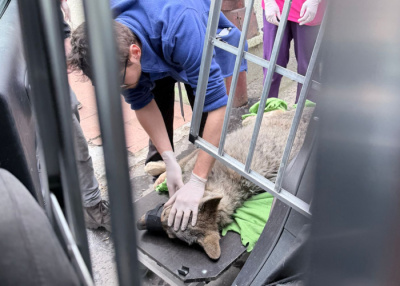
Our role involved an initial assessment of the animal’s health, age and sex, assisting the vet with sedating the wolf, transporting the wolf (actually a female wolf - a young, one-year-old female) to the veterinary clinic (in Gdańsk on Kartuska Street), consulting with the vets regarding the injuries, prospects for survival and treatment, and - finally - transporting the wolf to Koszalin to the centre of the “Larus” Foundation.
If we manage to cure the female wolf, we will carry out genetic testing to determine her place of origin, where she will be released. In that case, we will fit her with a collar containing a GPS-GSM transmitter, allowing us to monitor the animal’s future movements for up to two years.
- Are you often called out for such interventions? What challenges do you most frequently face? What is the most difficult, and what is the most rewarding, about such interventions?
- Interventions involving injured but alive wolves are rare; we’ve had six or seven such cases in Pomerania so far. Interventions involving dead wolves are much more common - there are several dozen of these every year.
The challenges lie in the uncertainty regarding the animal’s condition and deciding whether treatment and rehabilitation make sense in a given case - in many instances, the injuries are so extensive that, unfortunately, the only option is to euthanise the animal (and this is the most difficult part; of course, the final decision is made by a vet). Another challenge is the shortage of rehabilitation centres equipped to house wolves - currently, the nearest one is in Koszalin. It used to be even more difficult - several wolves from Pomerania had to be transported all the way to Bielsko-Biała for rehabilitation.
The most rewarding moments are, of course, releasing a recovered wolf back into the wild and continuing to monitor its fate.
- Recently, there has been a lot of misinformation about wolves, often designed to instil fear. What misconceptions do you think are the most common - and how do they compare with the facts?
- The most common myths are, of course, cases of alleged attacks on humans, which, upon closer inspection, turn out to be fabricated. In turn, much of the supposedly aggressive behaviour of wolves actually concerns individuals who do not realise they are dealing with a human (as I mentioned, wolves have poor eyesight).
There are also myths regarding population numbers - the problem here is the lack of nationwide population monitoring. The official data provided by the Central Statistical Office (GUS) is completely unreliable and certainly greatly overestimated. They are based on information gathered from Regional Directorates for Environmental Protection, which do not have wolf monitoring within their remit or remit, so they ask other bodies (e.g. forest districts, hunting clubs), which also lack reliable data. If one were to believe the official data, the Podkarpackie Province would have the highest wolf density in the world.
Experts and scientists specialising in wolves unanimously agree that this data is unreliable, regardless of whether they advocate strict species protection (such as prof. Sabina Nowak of the University of Warsaw) or hunting management (such as prof. Henryk Okarma of the Institute of Ecology of the PAS).
Other myths concern wolf behaviour, such as the structure of a wolf pack - myths about strict hierarchy and dominance (terms such as alpha, beta, omega, etc.), based on research conducted under artificial conditions in the 1950s, still persist. In reality, so-called packs are simply family groups, consisting of a parental pair and their offspring from the last 2-3 years. There are no struggles for dominance within them.
- Where is the best place to look for reliable information about wolves?
- There are many reliable sources - scientific publications, monographs, etc. - but from those that are widely available for free and accessible, I would recommend the regularly updated book 'Po sąsiedzku z wilkami', available as a free PDF (in Polish).
- Thank you for the interview!
What should you do if you come across an injured animal, e.g. following an accident?
1. Notify:
- the police and/or road services,
- a vet,
- the team at the Department of Vertebrate Ecology and Zoology, University of Gdańsk (tel. +48 58 523 61 41, contact dr M. Szewczyk: +48 604 532 116) and/or the “Wilk” Association for Nature (tel. +48 606 110 046).
2. Do not approach the injured animal closely, but from a safe distanc,e take a few photos or a video, which will allow specialists to make a preliminary assessment of whether it is indeed a wolf and what condition it is in.
3. If the incident took place near a busy road, secure the scene (using a warning triangle, etc.).