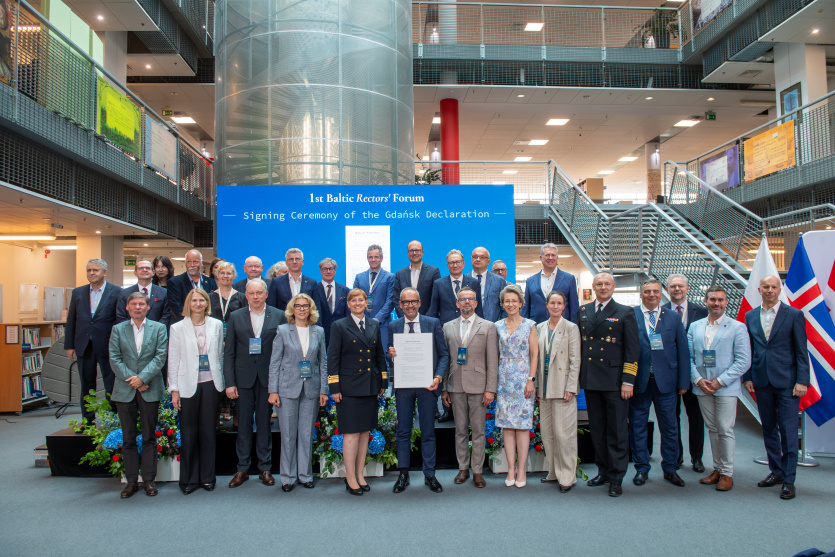
Signatories to the Gdańsk Declaration
The signing of the Gdańsk Declaration was the highlight of the 1st Baltic Rectors’ Forum, initiated and organised by the University of Gdańsk. Rectors and representatives of universities from nine countries in the Baltic Sea Region have committed to long-term cooperation in the areas of security, energy transition, innovation, and sustainable development. The document sets out a common course of action for the academic community in response to the most pressing challenges facing Europe today.
The declaration was signed at the conclusion of the Baltic Rectors’ Forum, which brought together in Gdańsk representatives of universities, public administration, business and international organisations from Poland, Germany, Denmark, Sweden, Finland, Norway, Lithuania, Latvia and Ukraine.
During the debates, participants discussed the region’s security in a changing geopolitical landscape, the energy transition, the security of critical infrastructure, the development of the blue economy, and cooperation between academia, business and public administration. The highlight of the Forum, however, was the adoption of the Gdańsk Declaration - the first joint document by the academic community of the Baltic Sea Region to define, in such a comprehensive manner, the role of universities in building the region’s resilience, security and competitiveness.

‘Today’s world needs not only strong states, but also strong partnerships. The Gdańsk Declaration shows that universities wish to be active co-creators of security and development in the Baltic Sea Region. We do not limit ourselves to identifying problems - we are committed to joint action, fostering innovation, educating leaders and building lasting bridges between academia, public administration and the economy. I believe that in a few years’ time, we will point to this very document as the beginning of a new phase of academic cooperation in our part of Europe,’ emphasised the Rector of the University of Gdańsk, prof. Piotr Stepnowski.
The signatories to the Declaration recognised that the future strength, resilience and competitiveness of the Baltic Sea Region depend on deeper cooperation between universities and public administration, business, civil society organisations, and international partners. They also pledged joint action to address challenges relating to energy security, climate transition, environmental protection, the development of strategic technologies, migration, public health, and democratic resilience. The document provides for the development of joint educational and research programmes, academic mobility, and joint and dual degrees. It also envisages closer cooperation with the business sector to boost innovation and entrepreneurship, support the energy transition - including initiatives such as the Baltic Energy Council - and develop future technologies such as artificial intelligence, cybersecurity, digitalisation, clean energy and resilient infrastructure. The signatories also emphasised the importance of safeguarding academic freedom and university autonomy, strengthening the civic mission of universities, and fostering dialogue and public trust. The Declaration sets out the conviction that universities not only conduct research and educate future generations, but also build bridges between nations, societies, and cultures.
Another key element of the document is the decision to establish the Baltic Rectors’ Forum as an annual event organised in turn by universities across the Baltic Sea Region. The Forum is set to become a permanent platform for cooperation between the academic community, public administration, business, and social partners. The next meeting will take place at the University of Klaipėda.
The Declaration adopted in Gdańsk sets out an ambitious vision for the Baltic Sea Region as one of the most innovative, safe and sustainable areas in Europe, and confirms the universities’ readiness to cooperate across borders and academic disciplines for the sake of a shared future.