
We present the profile of another winner of the National Science Centre's OPUS 29 competition: prof. Adriana Zaleska-Medynska from the Faculty of Chemistry, whose project ‘New surface-supported metal-organic framework thin films (SURMOFs) for molecules capturing and photoconversion’ received funding in the amount of PLN 3,299,920.
Professor Adriana Zaleska-Medynska
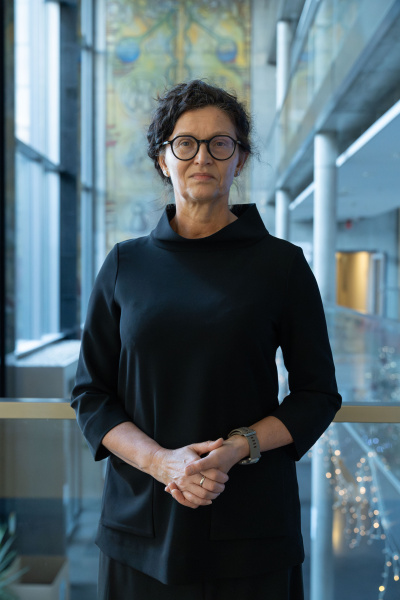
Head of the Department of Environmental Technology and the Photocatalysis Team at the Faculty of Chemistry, University of Gdańsk. She has been conducting research in the field of heterogeneous photocatalysis for over 25 years, first leading teams at the Faculty of Chemistry, Gdańsk University of Technology, and since 2012 at the University of Gdańsk.
She is the co-author of over 220 scientific articles (h-index = 51), 1 book, 18 patents, 12 patent applications and over 300 announcements presented at national and international conferences. She has completed internships abroad, including at the California Institute of Technology (USA), the University of California at Berkeley (USA), Stanford University (USA), Hokkaido University (Japan), and the Weizmann Institute (Israel). She has supervised 22 completed doctoral theses, co-supervised 1 completed foreign doctoral thesis, and is currently supervising 6 doctoral theses.
Since 2020, she has been the Director of the Fahrenheit Union of Universities in Gdańsk. She is a member of the Gdańsk Entrepreneurship Council, the Strategy Council of the Pomeranian Territorial Forum, the Climate Council established by the UN Global Compact Network Poland, and the Fahrenheit University Women's Club Association.
About the project
The project is being carried out in a consortium with the research group of dr hab. inż. Justyna Łuczak, prof. PG, from the Faculty of Chemistry at GdańskTech.
The subject of the OPUS project is to design new thin-film materials using metal-organic frameworks (MOFs), which will be used both for capturing gas molecules and sorption of pollutants from water, as well as in photocatalytic reactions (i.e. those occurring under the influence of UV-Vis radiation). Metal-organic frameworks are a relatively new class of materials with an ordered, porous structure. Susumu Kitagawa, Richard Robson and Omar M. Yaghi received the Nobel Prize in Chemistry this year for their research on them.
In this project, MOFs will be produced in the form of very thin layers on the surface of other materials (e.g. conductive materials), and the combination of at least two different MOFs in a sandwich structure will enable the sorption and photocatalytic functions of these materials to be combined or the production of materials that allow highly selective photocatalytic reactions to take place.
The team of scientists working on the project expects that these materials can be used, among other things, for the efficient production of hydrogen from water using solar energy or for the photochemical transformation of waste CO2 into useful chemical compounds.
‘In this reaction, the thin-film MOFs act as a photocatalyst, which means that they are excited by light (e.g. solar radiation) and, once excited, the electrons and holes formed on their surface initiate chemical reactions that break down the inert water molecule into oxygen and hydrogen (a pure energy carrier),’ explains prof. Adriana Zaleska-Medynska. ‘In the second type of reaction (CO2 photoconversion), the situation is similar - thin-layer MOFs act as a photocatalyst for this reaction, i.e. they are excited by light (e.g. solar radiation) and, once excited, the electrons and holes formed on their surface initiate chemical reactions leading to the transformation of carbon dioxide (CO2), a greenhouse gas, into useful chemical compounds that can be used as fuel or raw materials in the chemical industry.’
For more information on the results of the OPUS 29 and PRELUDIUM 24 competitions, read here.