
An honorary doctorate for the President of the French Republic, regulations for doctoral schools, and a self-assessment report on the quality of education were among the items on the agenda of the University of Gdańsk Senate meeting held on April 16, 2026.
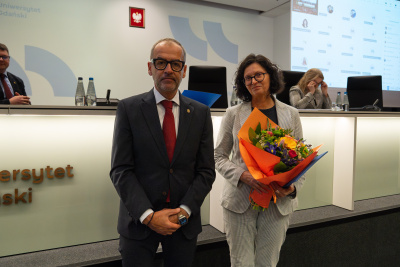
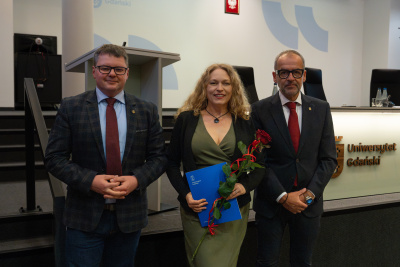
The Senate meeting was opened by the Rector, prof. dr hab. Piotr Stepnowski, who presented prof. dr hab. Adriana Zaleska-Medynska (Faculty of Chemistry) with the University of Gdańsk’s bronze medal. The professor has concluded her work as Director of the Fahrenheit Union of Universities in Gdańsk, and the medal is a token of appreciation for her contributions to the establishment and development of FarU. The Senate thanked prof. Adriana Zaleska-Medynska with a round of applause. Next, prof. dr hab. Danuta Gutowska-Owsiak (Intercollegiate Faculty of Biotechnology UG and MUG) received congratulations from the Rector on her appointment as a full professor.
Most Senators participated in the meeting online this time.
The next item on the agenda was a draft resolution of the University of Gdańsk Senate regarding the conferral of a doctor honoris causa of the University of Gdańsk title upon the President of the French Republic, Emmanuel Macron.
‘Last year, I approached the Office of the President of the French Republic with the initiative to honour the President. It was he - who has rendered exceptional service to the development of our University - who initiated the European Universities program,’ explained prof. Piotr Stepnowski. ‘Let me remind you that this was right after Brexit, at a time when Europe was facing questions about its future competitiveness, including in the areas of higher education and science. It should be emphasised that this momentum was reinforced by the President’s exceptionally charismatic speech at Charles University in 2017, in which he proposed the establishment of the European Universities program. Today, we know what enormous and positive effects this initiative has had, especially for universities in our country. Thanks to it, it has become possible to build strategic partnerships, intensify academic exchanges, conduct joint research, and create joint study programs. All of this is also being implemented at the University of Gdańsk within the SEA-EU alliance, and, in a nutshell, we can say that we owe this largely to the vision of President Emmanuel Macron,’ added the Rector.
Since representatives of the French President have conveyed that President Emmanuel Macron is willing to accept the highest honorary title from the University of Gdańsk, recognizing the validity of the presented rationale, and thus acknowledging his contribution to the establishment of the European Universities program, discussions were initiated regarding the possible conferral of the title during Emmanuel Macron’s upcoming visit to Gdańsk, scheduled for 20 April of this year; consequently, the procedures were expedited. Reviews for the conferral process were prepared by the rectors of SEA-EU partner universities: prof. Alfred Vella (University of Malta), prof. Casimiro Mantell Serrano (University of Cádiz) and prof. Pascal Olivard (Université de Bretagne Occidentale).
All submitted opinions emphasised President Emmanuel Macron’s pivotal, personal role in the conception and implementation of the European Universities initiative. It was noted that he not only formulated this vision but also consistently pursued its practical realisation, providing political, institutional, and financial support.
In conclusion, the Rector announced that due to the President’s busy schedule during his visit to Gdańsk, the conferral of the title, to ensure compliance with academic rules and ceremony, would take place at a later date.
Senator dr hab. Arkadiusz Modrzejewski, prof. UG took the floor:
‘Conferring an honorary title on the President sends a very important signal. At a time when we devote so much attention to the political dimension of European integration, it is worth recalling that the European Union also needs a strong social component. We must realise that as an academic community, we form a single community, also in the human, interpersonal dimension. The initiative launched by President Emmanuel Macron deserves to be honoured precisely because it emphasises the importance of this dimension. It shows that the European Union is not only about high politics, but also a community of values and social relations. That is why I consider this initiative fully justified. For the voice of the academic community is a voice in favour of integration-a voice reminding us of its value, especially today, when the significance of European integration is sometimes called into question.’
As the Rector added, the Senate’s position is pro-academic, pro-European, and at the same time pro-national: ‘Only by building strong ties in Europe can we also effectively strengthen our position at home.’
The University of Gdańsk Senate adopted the resolution unanimously.
Following this lengthy item, the floor was taken by the Vice-Rector for Research, prof. dr hab. Wiesław Laskowski, who presented the draft resolution of the University of Gdańsk Senate regarding applications for the Minister of Science and Higher Education’s awards to University of Gdańsk employees. He reminded the Senate that, in accordance with the regulation of the Minister of Science and Higher Education, the University of Gdańsk may nominate one candidate in each category of achievement. The Senate approved the nominations for:
- the Lifetime Achievement Award for prof. dr hab. Krystyna Bieńkowska-Szewczyk (Intercollegiate Faculty of Biotechnology UG and MUG),
- an award for scientific activity for dr hab. Łucja Bieleninik, prof. UG (Faculty of Social Sciences),
- an award for teaching activity for dr Elżbieta Mrożek, prof. UG (Faculty of Mathematics, Physics and Informatics),
- an award for implementation activities for dr Magdalena Chrzan-Dętkoś (Faculty of Social Sciences).
The Senators also approved another resolution, presented by prof. Wiesław Laskowski, concerning the nomination of dr Hanna Obracht-Prondzyńska (Faculty of Social Sciences) to the Polish Young Academy of the PAS.
The Rector gave the floor regarding subsequent resolutions to the Vice-Rector for Student Affairs dr hab. Urszula Patocka-Sigłowy, prof. UG, who presented them on behalf of the Vice-Rector for Education, dr Ewa Szymczak, prof. UG.
Two of them - the draft resolution of the University of Gdańsk Senate on amending the Regulations of Doctoral Schools and the draft resolution of the University of Gdańsk Senate on amending the Regulations of the Intercollegiate Doctoral School of Biotechnology of the University of Gdańsk and the Medical University of Gdańsk - included changes primarily concerning the scope of tasks of doctoral school councils.
‘A new section was introduced regarding the rules and criteria for conducting mid-term evaluations. At the same time, there are plans to remove the task of adopting the draft regulations of the Doctoral Schools. This authority has been transferred to the Senate,’ explained the Vice-Rector. ‘Provisions regarding the justification of doctoral students’ absences from classes have also been added, including the specification of the maximum duration of a break in studies and the identification of possible reasons for such a break.’
The regulations also clarify the requirement for doctoral students to provide a correspondence address. In the absence of such an address, which primarily affects foreign nationals, it will be necessary to designate a representative for service. Additionally, provisions regarding a doctoral student’s return from leave have been established.
During this meeting, the Senate did not vote on these resolutions because the school councils had not yet voted on the changes. Therefore, the vote will take place at a later date. Doctoral students will present their full opinion after the Senate vote. The draft regulations received a positive opinion from the Senate Committee on Education.
The Vice-Rector for Student Affairs also discussed the draft resolution of the University of Gdańsk Senate regarding the establishment of study programs for majors offered at the University of Gdańsk. The changes concern learning outcomes and adjusting the number of hours of professional internships in practice-oriented majors. All were approved by the Senate Committee on Education and endorsed by the University of Gdańsk Senators.
A draft resolution of the University of Gdańsk Senate was also adopted regarding the opinion on the Minister of Education’s commissioning of postgraduate programs launched at his request: Postgraduate Studies in Special Education on Inclusive Education, Postgraduate Studies in Educational Psychology with Pedagogical Training, and Postgraduate Studies in Early Childhood Development Support and Family Support.
The next item was the ‘Self-Assessment Report on the Quality of Education at the University of Gdańsk for the 2024/2025 Academic Year,’ also presented by Vice-Rector Prof. Urszula Patocka-Sigłowy. As she noted, the report includes, among other things, detailed information regarding the scope of modifications to study programs, covering all fields of study at the University of Gdańsk, down to the smallest adjustments, including changes relating to individual ECTS credits.
‘The modifications introduced resulted primarily from a systematic review of study programs and a consistent effort to improve the quality of education. They also constituted a response to the recommendations of the Polish Accreditation Committee, emphasised the Vice-Rector. ‘The report also includes information on the degree programs visited during the 2024/2025 academic year by PAC evaluation teams and the results of those evaluations. All visited programs received positive evaluations for a period of 2 or 6 years. An important element of the report is data regarding classroom observations. Over 520 classroom observations were conducted during the year under review, the results of which were overwhelmingly positive. In cases where shortcomings were identified, appropriate corrective actions were implemented, and subsequently, after the agreed-upon period had elapsed, follow-up observations were conducted.’
The final section of the document outlines directions for change and recommended actions for the faculties, faculty-level educational quality teams, and the University Educational Quality Assurance Team. The most important recommendations include:
- further strengthening the quality of teaching and staff competencies,
- development of interdisciplinary programs,
- development of international programs,
- standardisation and simplification of quality procedures.
The report was reviewed by the University Team for Quality Assurance in Education and the Senate Committee on Education.
The next report reviewed by the Senators concerned the activities of the Technology Transfer Office for 2025 and was presented by the Director of the TTO, Katarzyna Gronowska.
‘Our activities in 2025 were based primarily on three pillars: protecting the university’s intellectual property, cooperation with business, and training and outreach activities, as well as project implementation,’ said the TTO Director. (See the report)
During the open discussion, the Rector announced the reconstruction and renovation of Student Hall of Residence no. 9 in Sopot, as well as the 2nd Forum of Rectors of Poland and Turkey, which will take place on May 8 at the University of Gdańsk.
‘Minister Marcin Kulasek and his Turkish counterpart have confirmed their attendance. During the Forum, an intergovernmental agreement will be signed inaugurating academic and scientific cooperation between Poland and Turkey,’ said the Rector. ‘As you know, these relations are currently developing very dynamically. We see this not only in the context of economic or technological cooperation, but also - and this is particularly important - in the area of academic and interpersonal cooperation.’
He also reported on a visit to Uzbekistan, where, in the presence of the Minister of Science and Higher Education and his Uzbek counterpart, an intensification of international cooperation outside the European Union was announced. He added that Minister Marcin Kulasek, during a recent forum, invited participants to Gdańsk and pledged financial support for organising the event.
‘We are also one of the initiators of building a sustainable network of cooperation among universities in the Baltic Sea region, including, among others, Poland and Germany,’ said prof. Piotr Stepnowski. ‘This cooperation covers areas such as security, spatial planning, and other key challenges facing the region. Following Sweden and Finland’s accession to NATO, the geopolitical situation in the Baltic Sea region has undergone a significant change. Consequently, the importance of academic and scientific cooperation as the foundation for building lasting relationships and security is growing. We want to play an active and significant role in this process.’
The Director of the Institute of Political Science, prof. Arkadiusz Modrzejewski, asked that students be encouraged to participate in meetings with diplomats as part of the Diplomacy Incubator series organised by the Faculty of Social Sciences in cooperation with the Ministry of Foreign Affairs.
‘In the context of diplomatic and consular applications, one of the key requirements is proficiency in at least two foreign languages at the C1 level. This means that students of philology are particularly well-prepared for this career path and have a real advantage here,' emphasised the Senator. ‘This is an important distinction for us, because the Ministry of Foreign Affairs decided to implement this initiative specifically in cooperation with the University of Gdańsk, even though other leading academic centres in Poland were also considered. All the more reason for me to encourage you to take advantage of this unique opportunity and actively involve students in the proposed activities,’ he added in conclusion.
The next Senate meeting is scheduled for 21 May 2026.