
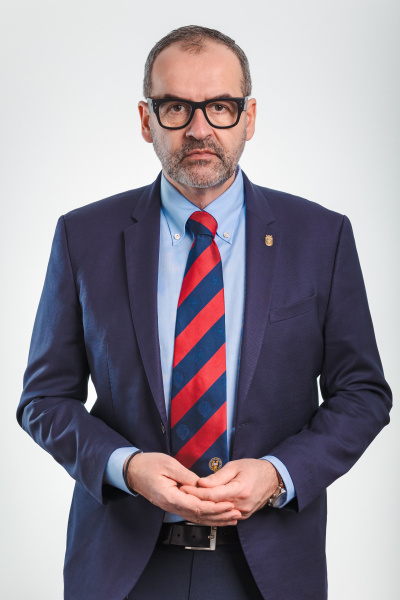
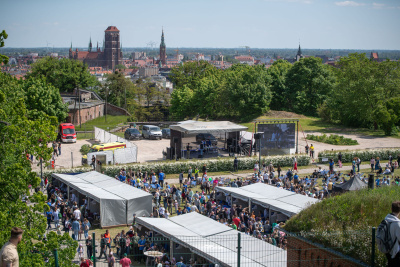
Over 80 educational booths, a stage, themed zones, and preventive health screenings. On May 24, the 5th Fahrenheit Science Picnic will take place on Góra Gradowa, where three universities (UG, GdańskTech, and MUG) will speak with one voice about science. What role does this event play in building relationships between the scientific community and residents? What role does local government play in fostering openness to science, and how can we encourage young people to discover new passions? University of Gdańsk Press Officer Magdalena Nieczuja-Goniszewska speaks with the Rector of the University of Gdańsk, prof. dr hab. Piotr Stepnowski.
Magdalena Nieczuja-Goniszewska: - This is already the 5th edition of the Fahrenheit Science Picnic. What role does this event play today in building relationships between science and the region’s residents - and what, in your opinion, is its greatest value?
Prof. dr hab. Piotr Stepnowski, Rector of the University of Gdańsk: - The Picnic is an open event - we invite both Gdańsk residents and tourists to attend. Year after year, more and more people are coming who are interested in science demonstrations, the very rich offerings of student clubs, and all the attractions prepared by the universities. We show that academic life and science can be engaging, fun, and understandable.
We organise the picnic on the birthday of Daniel Fahrenheit, the patron of our The Fahrenheit Union of Universities in Gdańsk and one of Gdańsk’s most famous scholars. In doing so, we combine contemporary scientific research and the popularisation of science carried out at our universities with the historical memory and heritage of our city. And that is also the value of this event.
Through the collaboration of researchers, students, and doctoral candidates in organising the picnic, during the event itself, as well as in cooperation with the city for the benefit of its residents and guests. Thanks to the knowledge conveyed here in an interesting and accessible way, we instil, I hope, in visitors a curiosity and a desire to explore the world around us. This is important for all of us, not just on a regional scale. I believe the picnic fulfils this mission excellently.
- The picnic is a joint initiative of the Fahrenheit Universities (UG, GdańskTech, MUG). What works best in practice in this collaboration, and what is the most difficult to achieve when three universities speak with one voice about science?
- I think the most amazing thing is that we managed to get so many people from three different universities on board for this idea, and they agreed to volunteer their time to promote science. Exactly - science, not just their own universities, as is often the case during various events held at other times.
From one picnic to the next, you can see how cooperation develops, for example, between science clubs - and this is where the picnic format works perfectly. And what’s the hardest part? The organisational logistics. It’s a massive amount of complex work, spanning weeks or even months. And then there’s the weather. We have no control over it, and the picnic takes place in the open-air grounds of Hevelianum on May 24. So far, luck has been on our side, and let’s hope it stays that way!
- The picnic focuses on hands-on experiences, workshops, and ‘face-to-face’ contact with science. How do such activities translate into trust in science and into the decisions of young people, such as their choice of the field of study?
- Such meetings, held in an open, casual setting outside the university walls, help bridge the gap between the world of science and its audience. When young people can talk to scientists, doctoral students, and students who are passionate about research, or take part in an experiment or workshop, science ceases to be an abstraction, a formula to “cram” for a test or the matura exam.
It becomes understandable and credible. In this way, we build trust and show that knowledge can be ‘tamed’. And if something is understandable, it’s easier to reject pseudoscientific lies and fake news.
Participation in popular science events sparks curiosity in young people, and sometimes - especially for those who are undecided - helps them discover their own aptitudes and interests or points them toward a specific educational path. Students who have had practical exposure to biology, physics, psychology, or the social sciences arrive at university later more aware of their choice - motivated and engaged.
That is why we view such events as an investment not only in the popularization of knowledge but also in the future of the entire academic community.
- The picnic would not have taken place without the city’s support. How do you view the role of local government in fostering openness to science?
- The City of Gdańsk is eager to participate in promoting science, which makes it easier to encourage residents to attend the picnic. It is also worth noting that the Gdańsk authorities award the most prestigious scientific prize - the so-called Pomeranian Nobel, namely the Jan Hevelius Science Award of the City of Gdańsk - as well as the Jan Uphagen Prize for Young Scientists.
In addition, the Mayor of Gdańsk funds three prestigious Fahrenheit Scientific Scholarships for the best doctoral students from abroad.
This demonstrates that our academic-local government cooperation is based on a solid partnership. This is also reflected in the annual university parade held in early October under the slogan ‘Long live science!’, during which the academic and local government communities jointly inaugurate the academic year.
- What would you say to people who think, ‘Science isn’t for me’?
- Come, experience it, try it, and see for yourself. You don’t have to be a scientist, but perhaps encountering science at a picnic will spark new passions in you. Maybe you’ll become a volunteer at the Marine Station in Hel or observe bird migration with ornithologists?
Maybe we’ll encourage you to attend open lectures or courses, or to enrol in the University of the Third Age? Our universities have enormous, diverse potential.
- How do you see the development of the Picnic and collaboration within the Fahrenheit University?
- The Picnic has certainly become a permanent fixture on the event calendar. Perhaps the growing attendance will prompt us to consider a larger venue, though Hevelianum seems like the ideal location.
As for university collaboration, joint initiatives allow us to more effectively develop areas critical to the region - from innovative technologies to energy transition projects, including offshore and nuclear energy.
FarU universities are strengthening their position as an expert and research base for investments of regional and national significance. Starting next academic year, the Academy of Music and the Academy of Fine Arts will join us, opening up new prospects for collaboration.
If we succeed in transforming the Fahrenheit Union of Universities in Gdańsk into a federation of universities, we will gain a strong entity based on modern science, innovation, an attractive educational offering, and cooperation with the social and economic environment.