
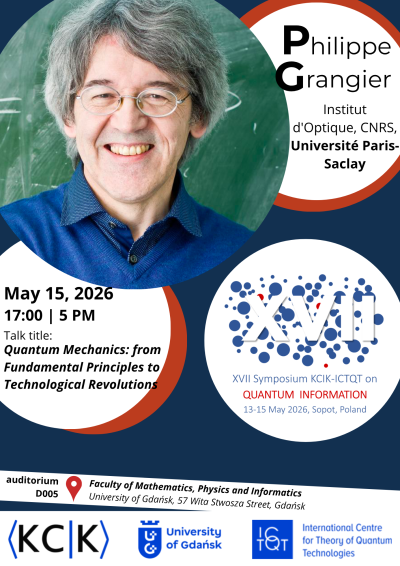
A French quantum physicist researching how to generate, measure and utilise single photons and entangled states under controlled laboratory conditions, who, together with Alain Aspect (Nobel Prize in Physics 2022), conducted classic quantum experiments in the early 1980s. - prof. Philippe Grangier will deliver a public lecture at the Faculty of Mathematics, Physics and Informatics, University of Gdańsk! The lecture, entitled “Quantum Mechanics: from Fundamental Principles to Technological Revolutions”, will take place on 15 May 2026 as part of the 17th KCIK-ICTQT Symposium.
The lecture will be of a popular science nature and will be delivered in English. Anyone interested in the fundamentals of quantum mechanics and how they translate into specific technological solutions is invited on Friday, 15 May 2026 at 5.00 pm to lecture theatre D005 at the Faculty of Mathematics, Physics and Informatics (57 Wita Stwosza Street).
Professor Philippe Grangier and his contribution to the research that led to the Nobel Prize
Professor Philippe Grangier is a French physicist specialising in quantum optics and the fundamentals of quantum mechanics, who has for many years been associated with, amongst others, the CNRS institutes and the research community developing photonic technologies. His work focuses on how to generate, measure and utilise single photons and entangled states under controlled laboratory conditions – resources that are key to quantum communication and computing.
In the context of the 2022 Nobel Prize in Physics (awarded to Alain Aspect, John F. Clauser and Anton Zeilinger for their experiments on photon entanglement, tests of Bell’s inequality and pioneering research into quantum information), Grangier was among the group of researchers who, together withAlain Aspect, conducted the seminal experiments of the early 1980s, in which correlations between photons were investigated and tests of Bell’s inequality were performed. Such measurements showed that the predictions of quantum mechanics (including the phenomenon of entanglement) cannot easily be replaced by ‘local’ theories with hidden variables. These results were not only of philosophical significance but also became the starting point for practical applications: quantum cryptography, quantum teleportation and photonic quantum networks.
For humanities scholars, it is worth noting that the 1982 experiment was mentioned in Michel Houellebecq’s book 'The Elementary Particles'.
In the years that followed, Grangier also developed methods for generating and characterising single-photon sources, as well as measurement techniques with ever-increasing sensitivity and ‘quantum purity’. He can be regarded as one of the key contributors to the early, experimental tradition of entanglement research, which led to the field being recognised.
KCIK-ICTQT Symposium
The annual KCIK-ICTQT Symposium on Quantum Information is one of the most important gatherings of the national quantum information community. It is specifically dedicated to researchers working at Polish institutions forming the KCIK (National Centre for Quantum Information) network and their collaborators from Poland and abroad. The aim of the Symposium is to strengthen cooperation between research centres, build lasting scientific relationships and enhance Poland’s position in the rapidly developing field of quantum technologies.
The event is organised by the National Centre for Quantum Information (KCIK) and the International Centre for Theory of Quantum Technologies (ICTQT) at the University of Gdańsk.
Further information: 17th KCIK-ICTQT Symposium on Quantum Information – KCIK.