

The SEA-EU alliance, of which the University of Gdańsk is a co-founder and active contributor, has received further funding from the European Commission. The partners will be given €7.2 million to implement the SEA-EU Next project, which marks the next stage in the development of the European Maritime University. This will enable them to develop joint educational programmes, scientific collaboration and academic mobility over the next two years. The University of Gdańsk’s budget for the project amounts to €752,000.
This is yet another significant success for the University of Gdańsk, which has been among the leaders of the European Universities initiative from the very beginning. Over the six years of its participation in SEA-EU, the university has helped to develop solutions that today serve as a model for European academic cooperation.
‘When we joined SEA-EU, we were convinced that this was one of the most important investments in the future of the University of Gdańsk. Today, it is clear just how much we have gained as a result. Our students, PhD candidates, researchers and staff are benefiting from opportunities that were hard to imagine just a few years ago. At the same time, we are increasingly making our mark as the University of Gdańsk and Poland within the European higher education landscape. I am delighted that we can help shape its future direction alongside Europe’s leading universities,’ says the Rector of the University of Gdańsk, prof. dr hab. Piotr Stepnowski.
The next stage of development
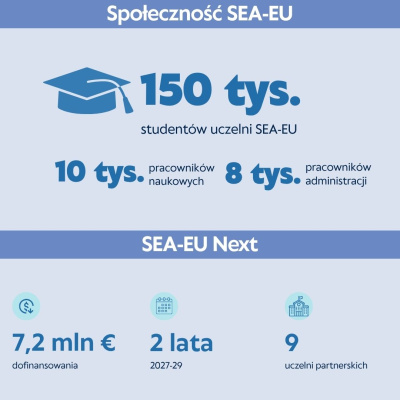
SEA-EU is among the twenty European University Alliances that have received funding to continue their cooperation until the launch of the new edition of the Erasmus+ programme. The European Commission has allocated nearly 150 million euros for this purpose, of which 7.2 million euros will go to the SEA-EU Next project.
The new project aims to further integrate the nine partner universities. Activities will focus on joint study programmes, creating opportunities for research development, increasing the mobility of students and staff, and jointly seeking solutions to challenges related to the development of coastal regions, climate protection, security and digitalisation.
‘Today, it is difficult to identify any group within our community that does not benefit from the opportunities created by SEA-EU. This further funding means that we will be able to expand these activities on an even grander scale,’ emphasises the Vice-Rector for Cooperation and International Relations, dr hab. Anna Jurkowska-Zeidler, prof. UG.
One campus, nine universities
One of the project’s most important initiatives will be the development of a joint digital platform, SEA-EU ONE, which will make it easier for students and staff to access the teaching, research and administrative services of all the universities forming the alliance. The system will also support the delivery of joint degree programmes: SeaBluE, MIPMAL and STORM.
The project also envisages further improvements to academic mobility, the development of joint study programmes and closer research collaboration.
‘Over the past six years, we have developed solutions that did not previously exist either within our alliance or at many of our partner universities. Today, we have the experience, trust and a proven model of cooperation. Thanks to this, we can undertake even more ambitious projects and consistently develop the SEA-EU partnership,’ says Marlena Rutkowska-Myzyk, project manager of SEA-EU 2.0 and co-author of the SEA-EU Next proposal.
News regarding the alliance’s offerings can be found on the Polish-language and English-language alliance websites.
