
We present the profile of another winner of the National Science Centre's OPUS 29 competition: dr inż. Emilia Gontarek-Castro from the Faculty of Chemistry, whose project ‘Nature-Inspired, Biodegradable and Fluorine-Free Membranes: Toward Sustainable Water Treatment Without Compromising Performance’ received funding in the amount of PLN 1,715,686.00.
Dr inż. Emilia Gontarek-Castro
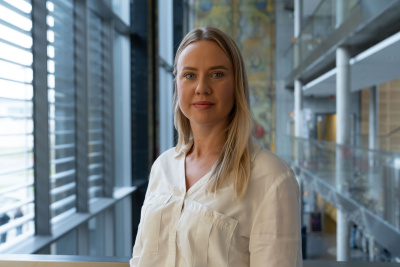
Assistant professor at the Department of Environmental Technology (Faculty of Chemistry). She graduated and obtained her doctorate (2022) at the Gdańsk University of Technology, specialising in the production and characterisation of PVDF-based hydrophobic membranes and nanomaterials.
Her work focuses on the application of membranes in water treatment and desalination processes, with particular emphasis on membrane distillation and environmentally friendly solutions. She is the author and co-author of numerous scientific publications (24) and a participant in national and international projects.
In May 2025, she received a grant under the UGrants-EUREKA programme, which she is implementing with a team led by dr hab. Ewelina Grabowska-Musiał and mgr Mateusz Baluk.
About the project
The project concerns materials for water purification, more specifically, special membranes used, among other things, in desalination. Currently, this is mainly done using fluorine-containing plastics, which are difficult to dispose of and can have a negative impact on the environment.
The aim of the project is to develop new, ‘green’ membranes inspired by nature – biodegradable, made from natural raw materials and fluorine-free, but at the same time as effective as current materials.
‘I want to show that it is possible to replace current materials with more environmentally friendly ones without compromising the quality of the water purification process,’ explains the scientist. ‘I expect to develop membrane prototypes that are biodegradable, fluorine-free, yet hydrophobic and effective in removing salts and contaminants. In the long term, the research may contribute to the development of more environmentally friendly water treatment technologies and reduce the use of materials that pollute the environment.’