
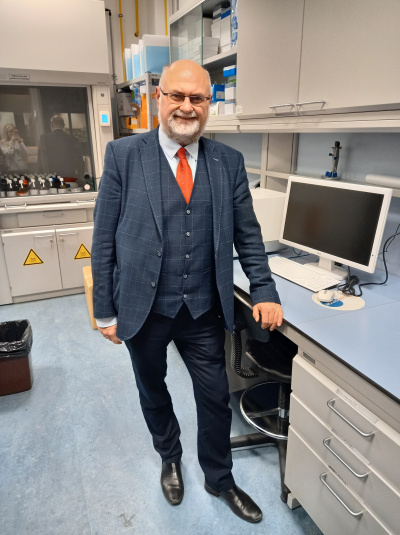
Professor Grzegorz Węgrzyn from the Faculty of Biology at the University of Gdańsk has been elected to the European Academy of Microbiology. This is a prestigious academic organisation, bringing together only about 150 microbiologists from across Europe. Election to this group takes place through the nomination of a candidate by a member of the Academy, and only members of the Academy are eligible to vote.
EAM members recognised the outstanding scientific work of prof. dr hab. Grzegorz Węgrzyn, who specialises in molecular biology, genetic diseases, and the genetics of bacteria and bacteriophages.
He led a team that developed a new and, at the same time, the first effective method of treating Sanfilippo syndrome, allowing the destructive processes of the disease to be halted. He is the author of over 500 articles, mainly in international scientific journals in the fields of molecular biology, genetics, biochemistry, and microbiology; he also holds 12 patents, including two for the treatment of mucopolysaccharidosis and Alzheimer's disease. He has received many prestigious awards, including the Prime Minister's Award, the Polish Genetic Society Award, the Jan Hevelius Science Award of the City of Gdańsk in the category of exact and natural sciences, and the American Society for Experimental Biology and Medicine Award.
Prof. Grzegorz Węgrzyn is also active in administrative and management bodies at the university and in scientific organisations and associations. Since 2019, he has been the president of the Gdańsk Branch of the Polish Academy of Sciences. He is also the vice-chairman of the Council for Scientific Excellence.
The European Academy of Microbiology (EAM), founded in 2009 by the Federation of European Microbiological Societies (FEMS), is an elite institution bringing together the most outstanding experts in the field of microbiology. The Academy promotes scientific excellence and is an influential voice in the microbiological community in Europe and worldwide.
Selection to the EAM is based on recognition of scientific merit and is an expression of appreciation for exceptional scientific achievements, research integrity and responsible leadership in science.
Academy members belong to a network of leaders shaping the future of microbiological sciences.
EAM members are involved in key initiatives such as:
- substantive support - developing evidence-based policy advice,
- publishing - collaborating with the prestigious journal microLife,
- mentoring - supporting future generations of microbiologists in their professional development,
- networking - active participation in the European and global ecosystem of scientific exchange.
Apart from the scientist from the University of Gdańsk, the only other Polish member of the EAM is dr hab. Anna Karnkowska, prof. UW from the University of Warsaw.
The official admission to the Academy will take place after 20 February.
Sincere congratulations to Professor Grzegorz Węgrzyn!