
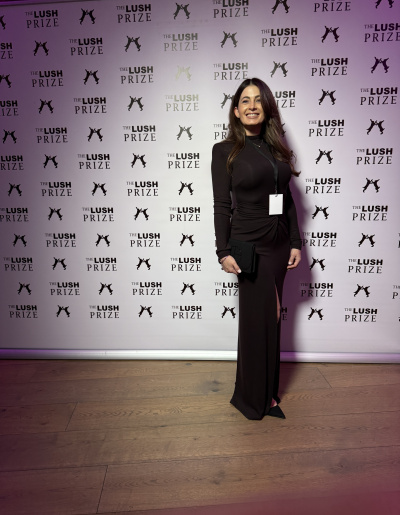
Dr Alicja Mikołajczyk from the Faculty of Chemistry at the University of Gdańsk is among the twelve winners of this year’s Lush Prize - the most prestigious award for research and initiatives aimed at reducing animal testing. The researcher from the University of Gdańsk was recognised in the Young Scientists category for “work contributing to the replacement of animal use in nanoparticle safety testing by developing advanced computational methods (in silico) for the toxicity assessment of complex, innovative, advanced materials”, project title: From QSAR to MINTOX and Nano-QSARmix: Computational Nanotoxicology for Animal-Free Joint Toxicity Assessment of Advanced Nano-Mixtures. Dr Alicja Mikołajczyk was the only Polish woman among the 60 nominees shortlisted for the 2026 Lush Prize and the first winner from Poland in the history of the award.
In her research, dr Alicja Mikołajczyk develops and applies New Approach Methodologies (NAMs), which support the modern, ethical and increasingly regulatory assessment of the safety of chemicals, nanomaterials and innovative advanced materials. NAMs include, among others, in vitro studies, conducted using cells, tissues or biological systems outside the body; in chemico methods, based on chemical and biochemical reactions; and advanced in silico methods, such as artificial intelligence, machine learning, molecular modelling, quantum chemistry and QSAR models.
The essence of this approach is to combine different data sources in a way that enables a more comprehensive and reliable assessment of potential risks. Data obtained from NAMs can be integrated within the framework of IATA (Integrated Approaches to Testing and Assessment), which supports the interpretation of results and decision-making in risk assessment. This is of particular importance not only for science, but also for industry and regulatory bodies, as it enables the creation of solutions that are more predictable, transparent and tailored to the actual needs of safety assessment.
Research in line with global trends

The approach developed by dr Mikołajczyk is in line with current global trends in human-relevant science, i.e. science based on data and models that reflect human biology and the mechanisms of action of chemicals and materials as accurately as possible. In practice, this means the ability to identify potential risks earlier, design safer products more effectively, and reduce the number of costly and time-consuming experimental studies. At the same time, this approach supports a gradual move away from animal testing towards methods that are more mechanistic, effective and biologically relevant.
Of particular importance in dr Mikołajczyk’s research are in silico methods, which enable the analysis of the properties, biological activity and potential risks of new and existing substances and innovative advanced materials at the early stages of their design (before they enter circulation). Through the use of artificial intelligence, machine learning and molecular modelling, it is possible to shorten research times, reduce costs, better target laboratory experiments and manage risk more effectively throughout the product lifecycle - from the concept stage, through design and implementation, to the assessment of safety in use.
‘I have been conducting research into the development of in silico methods supporting the design and risk assessment of innovative and advanced nanoparticle-based materials since the beginning of my academic career at the Faculty of Chemistry, University of Gdańsk, in the Laboratory of Environmental Chemoinformatics,’ says dr Alicja Mikołajczyk. ‘My initial inspiration was Prof. Tomasz Puzyn, who later became my PhD supervisor and mentor; he was the first to introduce me to the world of computational methods that enable research to be conducted responsibly - with both human safety and the reduction of laboratory animal use in mind. I view the Lush Prize award as an extremely important signal that science based on a human-relevant approach - that is, using data and models that reflect human biology and toxicity mechanisms as accurately as possible - is becoming a real direction for change in the research and safety assessment of chemicals and advanced materials, including innovative new-generation nanomaterials.’
Among the in silico methods developed by dr Alicja Mikołajczyk, a special place is occupied by the modelling of quantitative structure-activity relationships (Quantitative Structure-Activity Relationship, QSAR). The researcher was the first to attempt to adapt nano-QSAR methods to predict the toxicity of innovative and advanced materials based on mixtures of nanoparticles (Innovative Advanced Materials, IAMs). These nanomaterials pose a particular challenge to traditional safety assessment methods, as their properties and behaviour in biological systems depend not only on their chemical composition but also on a range of physicochemical parameters, such as particle size and shape, specific surface area, crystal structure, and interactions with components of the biological environment.
In the case of innovative advanced materials, this complexity is further increased; therefore, their reliable assessment requires modern, integrated and mechanistically grounded tools to support risk assessment. Due to their complex structure, IAMs based on mixtures of nanoparticles have never before been the subject of QSAR modelling.
The approach developed by dr Mikołajczyk has scientific, regulatory, industrial and ethical dimensions. It demonstrates that reducing animal testing does not mean compromising the quality of safety assessment. On the contrary - it can lead to more precise, mechanistic and regulatory science, better suited to the challenges of modern toxicology, materials chemistry and the concept of designing safe and sustainable products from the very earliest stages of their development (Safe and Sustainable by Design, SSbD).
‘Being among the winners of the Lush Prize 2026 is a huge honour for me, but also confirmation that shifting part of the risk assessment process from traditional laboratories to the computational realm is no longer a vision of the future or ‘science fiction’ - notes the winner. ‘This is a real direction for the development of modern science, which can support the design of safer and more sustainable chemicals and advanced materials - in line with the 1R principle and the Safe and Sustainable by Design concept.’
‘Success is rarely the result of a single breakthrough moment’
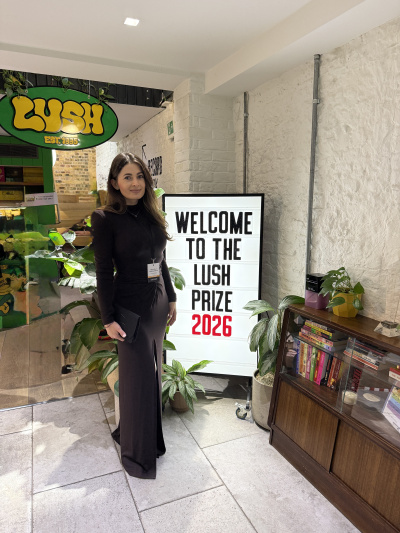
The Lush Prize has been awarded since 2012 and comprises five main categories: Science, Education, Public Awareness, Policy Advocacy and Young Scientist.
‘I have been waiting for this award for many years. That is why the Lush Prize is not only a huge motivation for me to continue my work, but also proof that it is worth aiming high and consistently pursuing your dreams. In science, as in life, success is rarely the result of a single breakthrough moment. More often than not, it is the sum of many attempts, failures, sacrifices and small steps that, over time, bring us closer to our goal,’ emphasises dr Alicja Mikołajczyk.
‘I would like my achievement to also serve as an inspiration for young women pursuing a career in STEM. I believe that courage, determination and faith in the value of one’s own work can open doors that initially seem very distant. Behind every success lie years of work, sacrifices, uncertainty, failures and small steps that are often invisible from the outside. The academic path can be demanding, but every step forward matters. By not even trying, we rob ourselves of the chance of success right from the start. That is why it is worth getting started - even when the goal seems distant - because consistency and courage can lead to achievements that previously seemed impossible. Especially when the goal is science that is more responsible, ethical and necessary for future generations,’ adds the scientist.
The ceremony for this year’s awards took place on 12 May 2026 in London.
More about the winners: 2026 Prize Winners - Lush Prize.
We warmly congratulate dr Mikołajczyk and wish her continued scientific success!