
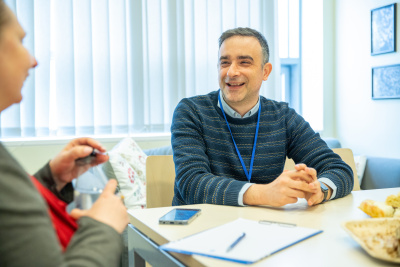
What are the changes in the approach to purifying wastewater and drinking water? How can we make toxic molecules more biodegradable? And what can we do at home, while choosing our cleaning products, to protect our waters? We talk to Professor Rui Martin from the University of Coimbra (Portugal), who visited University of Gdańsk as part of the 5th edition of the ‘UG Visiting Professors’ programme.
Dorota Rybak: - For starters, could you tell us a few words about your research interests in general?
Prof. Rui Martins: - I am a chemical engineer at the Department of Chemical Engineering at the University of Coimbra, Portugal. My research is mainly focused on wastewater treatment. Initially, I mostly worked with agro-industrial wastewater, which is very hard to be treated using traditional methods. It is due to the fact that those traditional methods rely heavily on biological processes and this kind of wastewater is very toxic, so it shows very low biodegradability. So, my research is focused on the development of the so-called ‘advanced oxidation processes’. They are based on the chemical oxidation of the wastewater and can be used - e.g. in the case of agro-industrial wastewater - to break the toxic molecules into smaller molecules that can be treated by biological means in the conventional way.
That was essentially my PhD topic; then, when I graduated and started teaching, my interests shifted towards municipal wastewater. It is very well treated by the biological means but with the development of analytical chemistry, it was detected that some compounds in low concentrations cannot be removed using biological processes. I am talking here about some pharmaceutical compounds or substances that we use in our everyday products, such as cleaning products or cosmetics. Currently, my scientific interests go towards developing advanced oxidation processes that can be used after the traditional, biological treatment of wastewater to remove those compounds.
- Yet, your research involving the visit to the University of Gdańsk concerns drinking water, not wastewater. How did it happen? And what is the project’s main focus?
- Well, the opportunity to carry out a project regarding the drinking water came up from the European Commission. We were able to apply for a Horizon Europe grant together with the group of Professor Adriana Zaleska-Medynska from the University of Gdańsk. This project is related to the following: you know that when we collect drinking water, we need to disinfect it. In order to do so, we need to use chlorine so that we are able to remove any bacteria and biological contamination that is in the water. This process is called chlorination. The main problem is that during the process of chlorination, some of the organic matter that is still in the water will interact with the chlorine and form what we call disinfection byproducts. They are organic chlorinated compounds that are typically toxic to many species, and also to human health. Of course, at the levels at which they are produced, they do not pose direct danger to us; the drinking water that we drink is safe. We can still drink it without concern.
- What is the problem that you are trying to solve, then?
- The problem is that we are collecting water from the rivers, among others, so the climate change and the pollution that we are putting into the rivers will lead to more polluted water. It means that when we collect the water for drinking purposes, we will need to apply more chlorine - i.e., we will need to increase the levels of treatment. So, the level of byproducts will also increase in the future. So one of the main objectives of this project - the project has several objectives, but in my case, and where also the University of Gdańsk is involved - is the development of technologies that are able to remove these let's say precursors, the organic matter that is in the source water before disinfection, so that we can avoid the formation of the byproducts. Moreover, we are also developing technologies to remove the disinfection byproducts from the disinfected water when their formation is unavoidable.
- And this project was the reason of your visit to the University of Gdańsk?
- Mainly, yes. We have several collaborations with the University of Gdańsk. We have a PhD student in common, Professor Adriana and I, that is working mainly with the contaminants of emerging concern for the wastewater treatment. So, there are a lot of elements we collaborate on. The current project is a grant, it finalises by the end of this year, but we are already thinking about new calls to try to keep this cooperation that we have between the University of Coimbra and the University of Gdansk - that was also one of the reasons to come here, to discuss face-to-face which kind of path we can follow afterwards.
- You also had some classes with students during your stay, right?
- Yes. I gave a lecture regarding the whole H2OforAll project. The project’s objectives are not only the treatment of water but also monitoring the water quality, which is very important. We are trying to develop techniques to evaluate the toxicity of the compounds that may be found in water because we need to be sure which of them are really toxic to target the ones that are harmful for human health.
Another basis for the project is public engagement. It's very important that people are engaged in the scientific part and that they know that the quality of water depends a lot on what we do in our houses. It refers to raising consciousness about how we can save water or how we can make better choices when we are buying, for example, cleaning products that won't pollute the water so much, because everything is connected.
That's why in our project, since we want to reach the general public, we have also a group from the University of Leeds in the UK that is in social studies. They can use our language from the chemists and so on, and try to put it in a simpler way to be understandable by the public.
- Can you tell us something about the European legislation regarding the water treatment?
- That was a topic of my lecture directed at PhD students. By the end of last year, the European Commission issued a new decree regarding urban wastewater, wherein the wastewater treatment plants will be obligated to follow up on some contaminants of emerging concern, like the pharmaceuticals and personal care products. They will need to implement what is called quaternary treatment (after the treatments that are already implemented) which should be efficient for removing those contaminants of emerging concern. And in that case, the advanced oxidation processes can be an option to be implemented. I think it's very important that the students know that. These technologies exist, we can optimise them, we can improve their efficiency, and it's a huge and important area of study for them to follow. There are many opportunities there, both research- and career-wise.
- Thank you for the interview.
Prof. Rui Martins visited the Faculty of Chemistry at the University of Gdańsk as part of the ‘UG Visiting Professors’ 2025 programme at the invitation of prof. dr hab. Adriana Zaleska-Medynska.