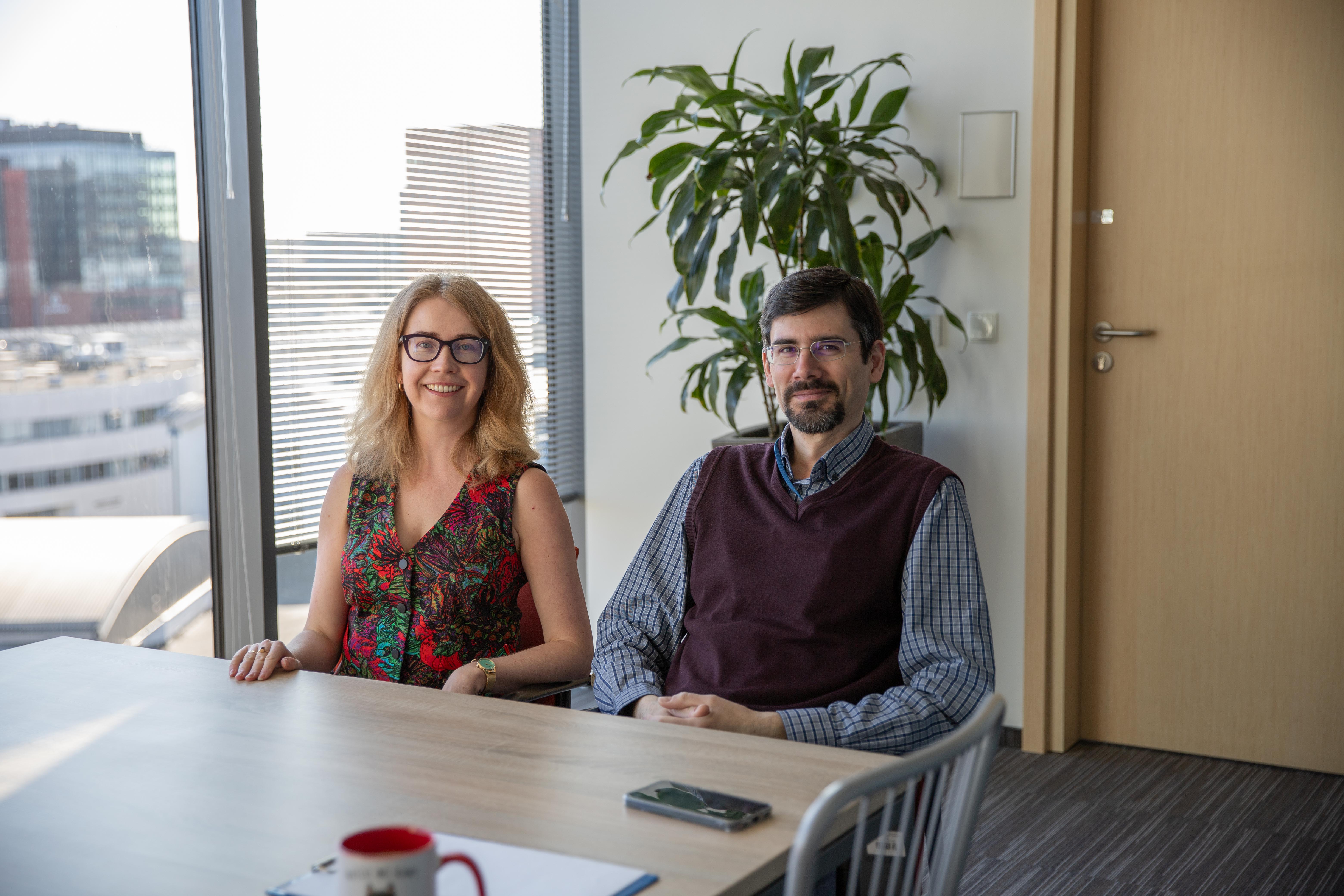
Do we change our minds or change our mind? How does artificial intelligence influence our use of language? Does the development of AI-supported automatic translators impact our learning of foreign languages? We talk to prof. Jakob Leimgruber from the University of Regensburg (Germany), who visited UG as part of ‘UG Visiting Professors’ programme, and dr Karolina Rudnicka from the Faculty of Languages at the University of Gdańsk, who invited him to this visit.
Dorota Rybak: - First, I would like to ask about your main research interests. What do you focus on?
Prof. dr Jakob Leimgruber: - My research focus is mostly on ‘world Englishes’, so English varieties around the world, from different perspectives, like language planning and policy, English in multilingual contexts, and so on. I typically analyse it in the traditional post-colonial settings, Asia particularly. I am also interested in language contact situations globally, usually with English being one of the languages involved.
- And what was the objective of your stay at the University of Gdańsk?
J.L.: - I visited the University of Gdańsk as part of the Visiting Professors programme. I gave a few guest lectures to your students, which gained quite a big interest - at one of them, there were about 80 people. Karolina and I also worked on the article together based on our joint research.
- So, your cooperation started before?
Dr Karolina Rudnicka: - We have known each other for quite some time, actually. We met in 2015, I think, in Freiburg, so it was already 10 years ago. Jakob worked there on his habilitation, and I worked on my PhD under the supervision of the same professor, Professor Christian Mair. This is how we met. Since then, we have both changed locations, the pandemic has happened, but we stayed in touch, and about three years ago, we reconnected a bit more.
J.L.: - Yes, we invited Karolina to Regensburg first for a visiting professorship. I think it was a five-week stay. And then, we were discussing this programme at the University of Gdańsk as well - we thought it was natural to continue our collaboration with these visits.
- What is the subject of the article you worked on during the visit?
J.L.: - Yes, so we're looking at four different varieties of English: British, American, Singapore, and Nigerian. And we're looking at the way in which objects agree with the possessors in the presence of the plural subject. It is highly specific, so let us give an example: people may change their mind or people may change their minds, they lose their life or they lose their lives. We are looking into this type of variations.
K.R.: - This is also my habilitation project, where I try to see the topic from many different aspects. And for the world Englishes aspect, I think it's great to collaborate with Jakob because he's an expert in that field, and we can join our insights.
- It is really interesting. There seems to be some philosophical background to it, doesn’t there?
J.L.: - Yes, there actually is, because some results show that abstract concepts differ. So if the concept is more abstract or metaphorical, or like a generalisation, then it's singular more frequently. Still, English prefers the plural; that's the default. But in some contexts, we will see how it works in different varieties, which also have the influence of other languages being spoken on the territory. Other cultures might treat this differently.
- What was your methodology for such a study? Did you analyse written materials or conduct an experiment?
J.L.: - We did both, actually. We started out with a corpus-based approach. We used an online corpus of blogs and websites, which is quite large. Then we moved to something that Karolina is better at: preference testing. We designed a survey to check personal preferences in using plural or singular forms in the four varieties of English we spoke about.
- What are the biggest challenges in conducting a cross-cultural study like yours?
K.R.: - One of the challenges we faced was to find a sufficient number of English speakers for preference testing, e.g. in Singapore. We had to reach out to our academic networks to get the responders for the experimental part of our research. What is also a problem is that we often don’t know what other languages are spoken by particular people, or what languages the texts we take from the corpus might be translated from.
- Can we consider these varieties of forms mistakes?
J.L.: - No, we can’t. They are simply local features, which we can see as some forms of dialects.
- Do you generally focus on places where English is an official language, or one of the official languages?

J.L.: - Yes and no. I started from researching post-colonial areas, like African states or India, but I am also interested in places where English is taught as a foreign language, e.g. continental Europe or Taiwan. Right now, English is the lingua franca; look at us, Poles and a German-speaking Swiss talking to each other in English.
- English became kind of the ‘default language’ while travelling or working in a multinational environment.
J.L.: - It’s true; I don’t speak Polish (yet), but I survived here with just English. However, when we think of travelling, there is also a different interesting factor: fewer and fewer things require human interaction. I can buy a ticket in an application, I can use self-checkout at the shop, and so on. But when human interaction is necessary, there’s usually no problem communicating in English.
- And we also have additional help in the form of dictionaries or translators in our phones.
J.L.: - Yes, we do. I was on the train platform the other day, and there was some kind of announcement about the train, so I just fired up Google Translate, let it speak into it, and I got at least a major idea of what was going on: that the next train was delayed. And these tools are getting more and more advanced very quickly. There's a lot of research into that now, actually, which I'm much less a part of, but colleagues in Regensburg do look into that: artificial intelligence, facilitating automatic translations. What is also interesting here is how it will influence the natural language.
K.R.: - That's also one of my research interests, AI and the influence of AI on the language. Will it speed up language change, or will it influence the way we use English or Polish? That's one of the things I'm working on and what I presented in Regensburg.
Jakob mentioned that the varieties of English he conducted a lot of research on have many distinctive features that are not mistakes - they are just features. But when we put the text into AI and make AI correct, enhance, or just rewrite it, then these features get lost. And then, is it still the same variety? Or what is it then? These are all very timely questions.
- I use some AI-based language tools, and I must say that quite a lot of my work with them is dismissing their suggestions. They have very specific ‘preferences’: active voice, shorter forms - there can’t be in order to, only to.
K.R.: - I actually wrote a paper on that! I was seeking the answer to the question of whether ‘in order to’ has to go.
J.L.: - Well, these tools are extremely helpful, especially to the people who are able to use them critically and reject some of the suggestions or answers. The problem might start with the younger generations, if they just learn to accept whatever they get out of it, without any questioning. We can say the same about some IT skills in general, because it goes beyond linguistics now. We are the generation that saw computers entering our homes, and we are used to dealing with their shortcomings; we are able to do so. But younger people don’t need to deal with them; they are used to the fact that they just work. So they may have a hard time spotting a problem when one arises.
- I also wanted to ask if you came across some interesting influences between different versions of English on each other.
J.L.: - Yes, I think so. There is one of our projects in Singapore that is a large corpus of WhatsApp messages. It is a very informal, very young type of language, written/texted. It's quite nice to get a look at what young people use these days. And there are lots of local features, of course - Singlish, Singapore English - which is interesting, but there's also a lot of what I think are global youth online forms. You know, all that slang, like smash and all the other words. Maybe people use them here as well. I know they do in Germany as well; they entered the German youth language. So in a way, I guess that's probably originated from the States or from language users elsewhere, and it's sort of spread also into other varieties. It has risen from a local to a global form.
Social media probably helps in disseminating these forms, but also streaming services, like Netflix and all the others. I mean, people can watch American series in the original. There are quite popular British ones as well, currently, and I don't know whether that's going to have any impact at the global level.
- I also think of maybe some gamers' community because when they use multiplayer, they mostly communicate in English, but in different varieties, creating their own language.
K.R.: - Students are usually very interested in this kind of topic. I don't know anything about it, but I always have students coming to me and saying, ‘We want to write about the language of gamers.’ Probably because they are gamers themselves, they are interested in it - they see that it influences them, and they hear it as well.
I am not an expert on that, but I know that there is a lot of research on how gaming impacts the learning of the language, on its usefulness in the process of learning. There is a body of research on that.
- Thank you for the conversation.