
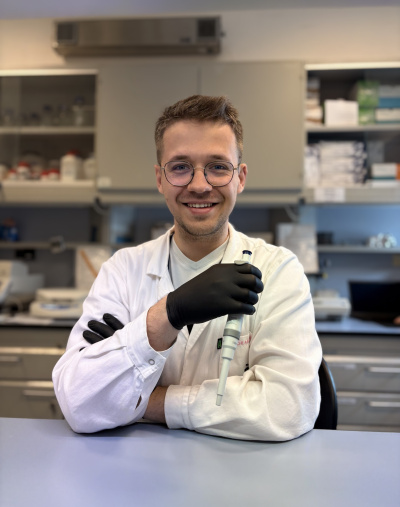
We present a profile of dr Łukasz Grabowski, a lecturer in the Department of Molecular Biology at the Faculty of Biology, University of Gdańsk, and recipient of the prestigious START grant from the Foundation for Polish Science in the field of microbiology. The START programme is the FPS’s longest-running fellowship scheme, supporting outstanding young scientists across all fields of science.
Dr Łukasz Grabowski was awarded a PhD in biological sciences in 2023 at the Institute of Biochemistry and Biophysics of the PAS. He is the author of 26 scientific papers published in renowned international journals, such as Nature Communications, Frontiers in Immunology, Apoptosis and Virology.
His research interests focus on the safety of antimicrobial therapies, the interactions of bacteriophages with the immune system, and the search for new biologically active compounds with anti-cancer potential.
About the research
In the field of research into natural compounds with anti-cancer potential, dr Łukasz Grabowski collaborates with prof. Holger Lode and dr Sascha Troschke-Meurer from the Department of General Paediatrics and Paediatric Haematology and Oncology at the Medical University of Greifswald, as well as with prof. Teresa Stachowicz -Stencel from the Department and Clinic of Paediatrics, Haematology and Oncology at the Medical University of Gdańsk. The research focuses on the identification and characterisation of natural compounds exhibiting potential cytotoxic activity against paediatric cancer cells, in particular neuroblastoma.
In parallel, the researcher is developing research on bacteriophages in collaboration with prof. Krystyna Dąbrowska from the Ludwik Hirszfeld Institute of Immunology and Experimental Therapy of the PAS. The project focuses on analysing the molecular safety mechanisms of phage therapy and the effect of bacteriophages on immune system cells.
Dr Łukasz Grabowski is currently carrying out a project funded by the National Science Centre, under the Miniatura 9 programme, concerning the role of bacteriophage DNA as a potential regulator of immune processes. At the same time, he is conducting research into the effect of Baltic cyanobacterial metabolites on neuroblastoma cells, aimed at identifying new candidates for anti-cancer drugs.
‘My research focuses on the molecular safety mechanisms of antibacterial therapies used in poultry, with particular emphasis on the interactions between bacteriophages, antibiotics and the host’s immune system. “I combine techniques from microbiology, immunology and molecular biology in an effort to understand how antimicrobial therapies affect immune cells and the body’s homeostasis,’ explains dr Łukasz Grabowski.
As the scientist emphasises, the aim of the research is to develop safe therapeutic strategies based on bacteriophages as an alternative to antibiotics in the face of growing antibiotic resistance.
‘In my research, I have demonstrated, amongst other things, that phage therapy in a poultry model - unlike antibiotic therapy - does not disrupt the host’s immune homeostasis. I have also described sex differences in the immune and behavioural responses of mice following administration of phages or antibiotics, which highlights the need to take sex into account in preclinical studies,’ adds the START programme laureate. ‘The NSC Miniatura 9 project currently underway aims to determine whether phage DNA can initiate autophagy in T lymphocytes and macrophages, thereby influencing their immune functions and the safety of phage use in therapy.’
The START scholarship from the Foundation for Polish Science is awarded to the most outstanding young researchers under the age of 30 for their scientific achievements to date. The annual scholarship amounts to PLN 30,000.